One of the most common questions we hear from business owners and IT managers is: "How much does it cost to run a network cable?" The answer depends on several factors, but we can give you real numbers based on hundreds of commercial cabling projects across Ontario. This guide breaks down per-drop pricing, what's included, what drives costs up or down, and how to budget for your project.
Per-Drop Pricing by Cable Type
A "drop" is a single network cable run from a patch panel in your server room or telecom closet to a wall jack at a desk, access point, camera, or device. Here's what you should expect to pay in 2026 for a professionally installed and certified drop:
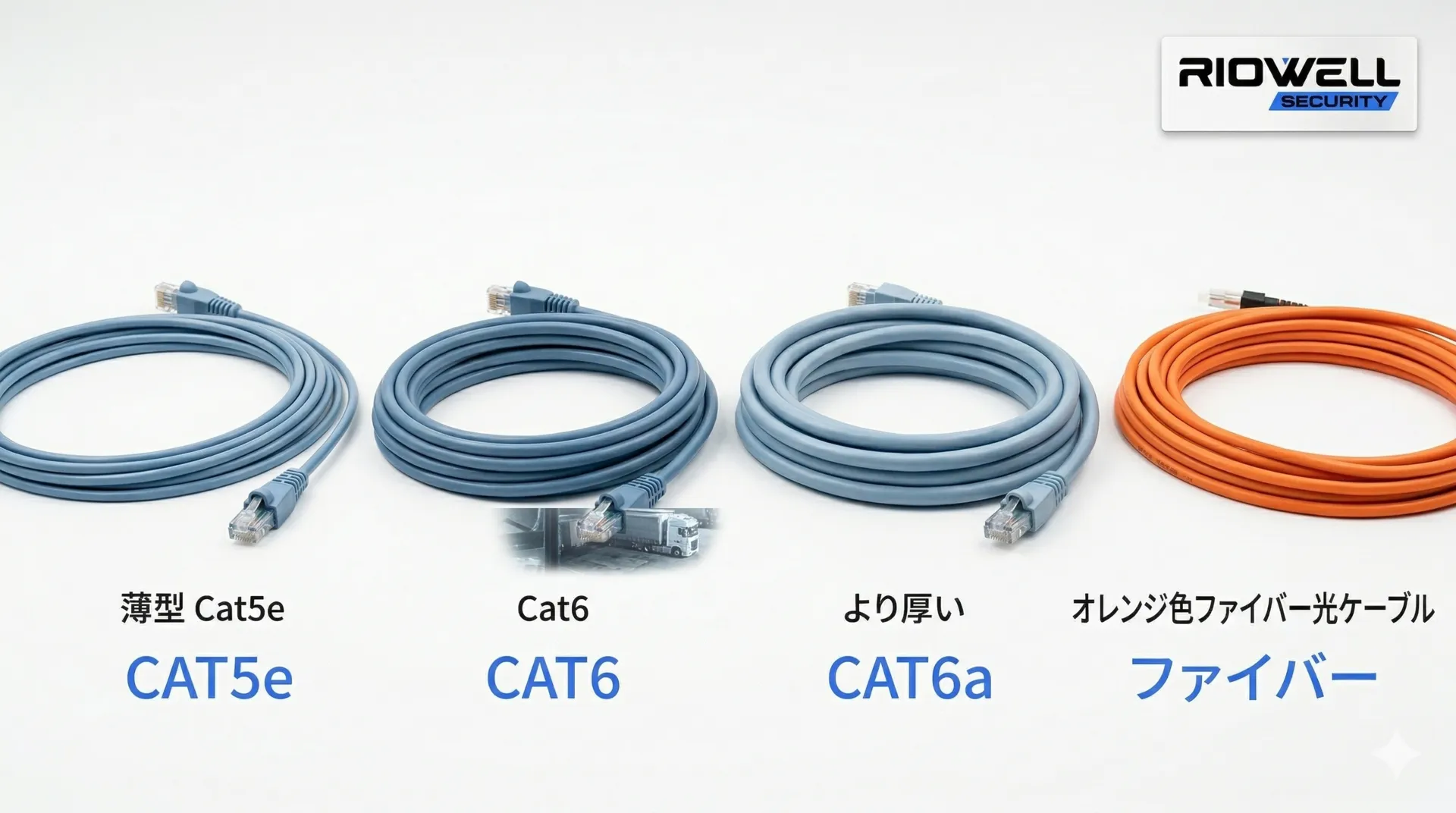
- Cat5e: $100–$200 per drop. Cat5e supports speeds up to 1 Gbps and is still adequate for basic office internet, VoIP phones, and low-bandwidth devices. It's becoming less common in new installations because the price difference between Cat5e and Cat6 has narrowed significantly, but it's still a valid option for budget-conscious projects where gigabit speed is sufficient.
- Cat6: $150–$300 per drop. This is the current standard for most commercial installations. Cat6 supports 10 Gbps at distances up to 55 metres and 1 Gbps at the full 100-metre specification. For the vast majority of office, warehouse, and retail environments, Cat6 is the sweet spot of performance and cost.
- Cat6a: $200–$400 per drop. Cat6a supports 10 Gbps at the full 100-metre distance. It's thicker, heavier, and more expensive to terminate, but it's the right choice for environments that need sustained 10-gigabit throughput — data centres, healthcare facilities with heavy imaging workloads, or buildings where you want infrastructure that's future-proof for the next 15–20 years.
- Fibre optic (single-mode or multi-mode): $300–$800+ per drop. Fibre is used for long-distance backbone runs between buildings, floors, or telecom rooms — not typically for individual desk connections. The higher cost reflects the specialized termination equipment and skills required. If you're connecting buildings across a campus or running backbone between floors, fibre is the right tool.
What's Included in a "Drop"
When a cabling contractor quotes you a per-drop price, here's what should be included. If any of these are listed as extras, ask why:
- Cable run: The physical cable from your patch panel to the wall jack location, routed through ceiling space, walls, or conduit as needed.
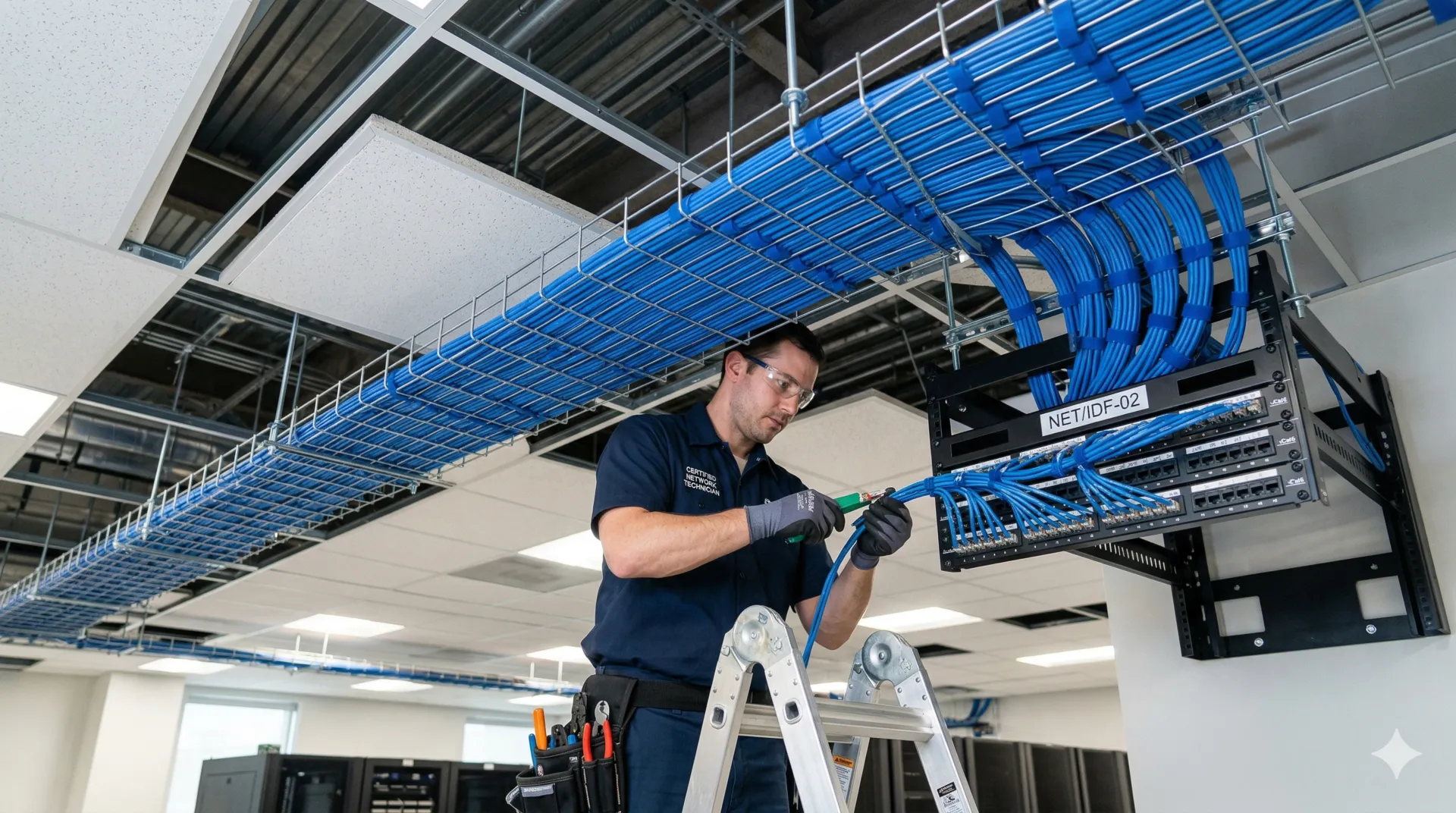
- Termination at both ends: The cable is terminated with an RJ45 jack at the wall plate and punched down to a patch panel port in your telecom closet. Both ends are done to TIA/EIA-568 standards.
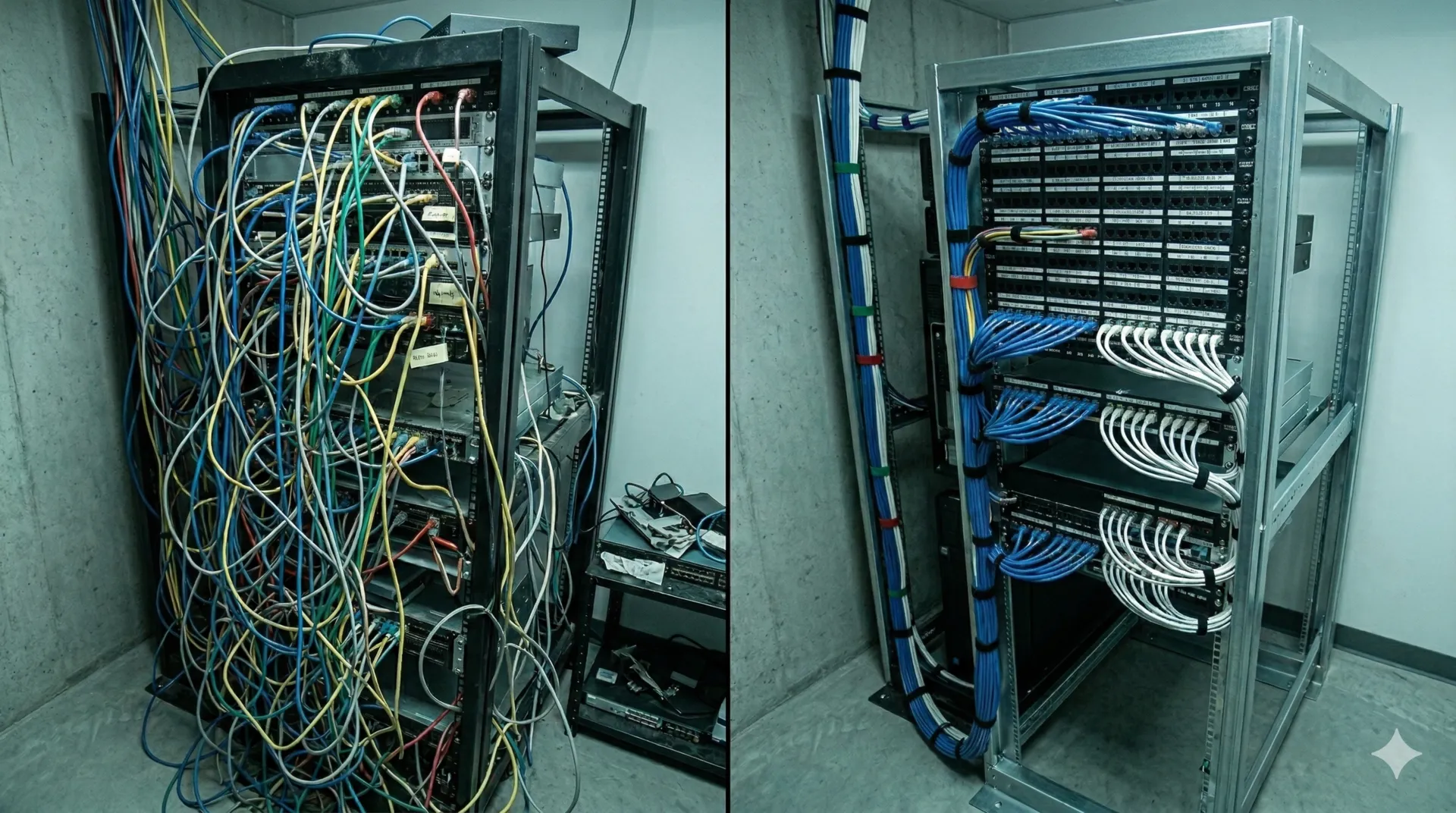
- Patch panel port: Your cable lands on a labelled port in the patch panel. A properly organized patch panel is the backbone of a manageable network.
- Testing and certification: Every drop is tested with a cable certifier (like a Fluke DSX) that verifies the cable meets its rated specification for length, attenuation, crosstalk, and return loss. You should receive a printed or digital test report for every drop. This is non-negotiable for any professional installation.
- Labelling: Both the wall jack and patch panel port are labelled with a matching identifier. This sounds minor until you're troubleshooting a network issue and can't figure out which cable goes where.
What Drives Costs Up
The wide range in per-drop pricing exists because not all cable runs are equal. Here are the factors that move you from the low end of the range to the high end:
Ceiling Type
This is the single biggest cost factor after cable type. Drop tile (suspended) ceilings are the easiest — you push up a tile, lay the cable across the grid, and drop it down where you need it. Drywall ceilings require cutting access holes, fishing cables through joist bays, and patching afterward. Concrete ceilings (common in industrial buildings and parking garages) require surface-mounted conduit or core drilling, which adds significant labour. Expect a 30–50% premium for drywall and up to double for concrete compared to drop tile.
Run Distance
A 15-metre run from the telecom closet to a nearby office costs less in materials and labour than a 70-metre run to the far corner of a warehouse. Longer runs also require more careful routing to avoid interference sources.
Wall Fishing
Getting a cable from the ceiling down through a finished wall to a wall plate is one of the more labour-intensive parts of the job. In a wood-framed wall with insulation, a skilled technician can fish a cable in 15–20 minutes. In a steel-stud wall with fire blocking or in a concrete block wall, it can take an hour or more per drop.
Quantity Discounts
Most cabling contractors offer volume pricing. If you're running 5 drops, you're paying the high end of the range because the mobilization cost (driving to your site, setting up ladders, unspooling cable) is spread across only a few drops. At 20+ drops, the per-drop cost decreases meaningfully — typically 15–25% below the single-drop price — because the setup overhead is amortized across more work.
Certification
Reputable contractors include Fluke certification in their per-drop price. Some lower-priced quotes exclude it and charge $15–$30 per drop extra for testing. Always confirm whether certification is included. An untested cable run is a gamble — you might discover it fails six months later when you plug in a PoE access point and it won't negotiate at full speed.
New Construction vs. Retrofit
If you're building a new office, warehouse, or retail space, cabling should happen during the rough-in phase — after framing and before drywall goes up. At this stage, cable runs are fast and easy because everything is open. Per-drop costs in new construction are typically at the low end of each range.
Retrofit projects in occupied, finished spaces cost more because of the access challenges described above. You're working around furniture, employees, existing cabling, and finished surfaces. A retrofit drop that would cost $175 in new construction might cost $250–$300 in a finished office. Plan for this in your budget and, if possible, schedule cabling work during a renovation or tenant improvement project when walls are already being opened.
Bulk Pricing Example
Here's a real-world example to illustrate how volume affects pricing. A 40-drop Cat6 installation in a single-storey office with drop tile ceilings, telecom closet centrally located, all runs under 50 metres:
- Per-drop price: $165
- Total for 40 drops: $6,600
- Includes: All cable, termination, patch panel, Fluke certification, labelling, and cleanup
Compare that to a 6-drop project in the same building at $250 per drop ($1,500 total). The per-drop price is higher because the fixed costs of the project — travel, setup, patch panel, certification equipment — are spread across fewer drops.
How to Get an Accurate Quote
To get a realistic estimate, provide your cabling contractor with:
- Number of drops needed
- Cable type (Cat6 is the default unless you have a specific reason for Cat6a or fibre)
- Building type and ceiling construction
- Approximate run distances (or a floor plan)
- Whether this is new construction or retrofit
- Whether you need anything beyond standard data drops (fibre backbone, outdoor-rated runs, plenum-rated cable for air-handling spaces)
Get a Cabling Quote
We install and certify structured cabling for commercial properties across Ontario — offices, warehouses, retail, healthcare, and industrial facilities. Every drop is Fluke-certified, labelled, and documented. Whether you need 5 drops or 500, we'll give you a straightforward per-drop price with no hidden fees. Call (905) 550-0490) or visit our networking and cabling page for more details.