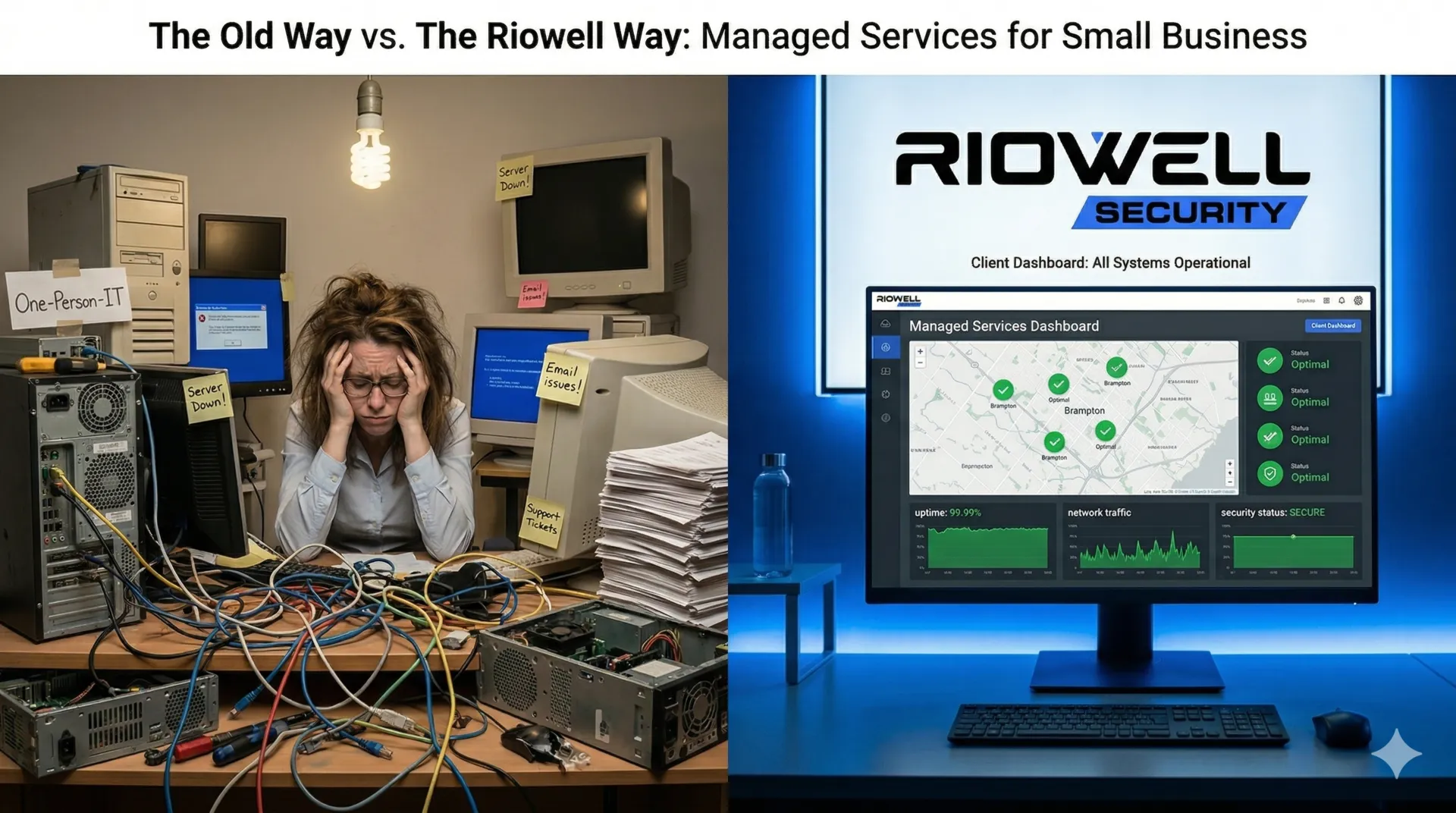
Every growing business hits this question eventually: should we hire an IT person or outsource to a managed service provider? The surface-level comparison — salary vs. monthly fee — makes it look straightforward. But the real total cost of ownership includes a lot more than what shows up on a pay stub or an invoice. Let's break it down honestly.
The True Cost of In-House IT
Hiring an IT generalist in Ontario in 2026 typically means paying a salary of $65,000–$90,000 per year depending on experience, location, and specialization. But salary is just the starting point. Here's the full loaded cost:
| Cost Component | Annual Estimate | |---|---| | Base salary | $65,000–$90,000 | | Benefits (15–25%) — health, dental, RRSP matching, EI, CPP | $9,750–$22,500 | | Training and certifications — annual continuing education, vendor certs | $2,000–$5,000 | | Tools and licences — RMM software, ticketing system, security tools, backup platforms | $3,000–$8,000 | | Recruitment costs — job postings, interviewing time, possible recruiter fee (15–20% of salary) | $5,000–$18,000 (amortized) | | Total loaded cost | $84,750–$143,500/year |
That's $7,000–$12,000/month for one person. And that one person takes vacation (3–4 weeks), gets sick, and eventually leaves — at which point you start the recruitment cycle again with 2–4 months of hiring time and the inevitable knowledge gap during the transition.
The True Cost of Managed IT
Managed IT services for a business with 15–40 employees typically cost $2,000–$5,000/month, depending on the number of users, devices, and the service tier. For comparison:
| Cost Component | Annual Estimate | |---|---| | Monthly managed service fee | $24,000–$60,000 | | Project work — migrations, major upgrades, new deployments (billed separately) | $5,000–$15,000 | | Total annual cost | $29,000–$75,000/year |
That's roughly 35–65% the cost of an in-house hire, depending on the tier and your business size. But the dollar comparison alone doesn't tell the full story. What matters is what each option actually delivers.
The Coverage Gap Problem with In-House IT
One IT person is one person. That sounds obvious, but the implications are significant:
- Vacation and sick days: Your IT person gets 3–4 weeks of vacation plus sick days. That's roughly 20–25 business days per year where your IT support is either absent or handled by someone unqualified. When a critical system goes down during their two-week vacation in August, who handles it? Usually nobody — or a panicked call to a break-fix provider at emergency rates.
- Specialization limits: IT is not one discipline. It's networking, cybersecurity, cloud infrastructure, desktop support, server administration, backup and disaster recovery, compliance, vendor management, and project management. One person cannot be a network engineer AND a security specialist AND a cloud architect AND a helpdesk technician. They'll be competent at some of these and weak at others. The areas where they're weak become your blind spots.
- Turnover risk: The average IT professional stays at a job for 2–3 years. When they leave, they take institutional knowledge with them — the undocumented configurations, the workarounds, the passwords stored in their head. If documentation wasn't rigorous (and it rarely is with a solo IT person), the replacement starts from scratch. The transition period is 2–6 months of reduced capability.
- No second opinion: A solo IT person makes every technical decision alone. There's no peer review, no second set of eyes on security configurations, no one to catch mistakes. In a managed service, every major decision passes through a team with collective expertise.
What Managed IT Delivers That One Person Can't
A managed IT provider gives you a team, not a person. That team typically includes helpdesk technicians for day-to-day support, network engineers for infrastructure design and troubleshooting, security specialists for threat management and compliance, cloud architects for Microsoft 365, Azure, and AWS environments, and a virtual CIO (vCIO) for strategic planning and budgeting.
You get access to all of these specializations for less than the cost of one generalist. The provider's tools and licences are included in your fee — you don't pay separately for RMM software, monitoring platforms, or security tools. Coverage doesn't stop when someone goes on vacation because there's always someone available. And turnover at the provider doesn't affect you because the team maintains shared documentation.
Response times are contractually guaranteed — typically under 1 hour for critical issues, under 4 hours for standard requests. Try getting that guarantee from an employee who's also juggling 15 other tasks.
When In-House IT Makes Sense
There are legitimate scenarios where hiring in-house is the better move:
- 50+ employees: At this scale, you have enough IT work to keep a full-time person genuinely busy — and potentially enough budget for two, which solves the coverage gap problem.
- Dedicated IT needs: If your business runs proprietary software, custom-built systems, or specialized equipment that requires hands-on attention daily, an in-house person who knows those systems intimately is valuable in a way an external provider can't match.
- On-site presence required: Manufacturing floors, warehouses with constant equipment issues, or healthcare facilities where immediate hands-on response is critical may need someone physically present during business hours.
- Regulatory requirements: Some compliance frameworks require dedicated internal IT staff with specific clearances or certifications that outsourced providers can't satisfy.
When Managed IT Wins
For businesses with 5–50 employees, managed IT wins in the majority of cases. You get broader expertise, better coverage, lower total cost, and contractual accountability. You're not dependent on one person's knowledge, availability, or mood. Your IT budget is predictable — a fixed monthly fee instead of salary surprises, emergency contractor bills, and unplanned tool purchases.
The sweet spot for managed IT is the business that's large enough to have real IT needs (multiple users, cloud applications, cybersecurity concerns, compliance requirements) but not large enough to justify a full internal IT department. That's most businesses in the 10–50 employee range.
The Hybrid Approach: Best of Both Worlds
For mid-size companies (30–75 employees), a hybrid approach often makes the most sense. Hire one IT person for on-site, day-to-day support — the person who knows your building, your people, and your quirks. Then partner with a managed provider for the specializations your in-house person doesn't have: cybersecurity management, cloud architecture, after-hours support, and strategic planning.
This gives you the institutional knowledge and physical presence of an internal hire, plus the breadth of expertise and 24/7 coverage of a managed team. The managed provider also serves as a safety net during your IT person's vacation, sick days, and eventual departure.
The cost of hybrid (one mid-level salary plus a basic managed tier) is typically $90,000–$130,000/year — less than two full-time hires but with significantly broader coverage than either a solo IT person or managed service alone.
Making the Decision
The question isn't "which is cheaper?" — it's "which gives us reliable, comprehensive IT support at a cost that makes sense for our size?" For most Ontario businesses under 50 employees, managed IT delivers more coverage at lower cost with less risk. For larger businesses, in-house with managed supplementation is the pragmatic choice.
If you're weighing this decision for your business, we'll give you an honest assessment — including telling you if in-house makes more sense for your situation. Call us at (905) 550-0490) or use the contact form to schedule a free IT consultation. No pitch, just a straightforward comparison tailored to your business.