We install security cameras for a living, so you might expect us to tell you cameras solve everything. They don't. Cameras are a critical layer of security — but in certain situations, they're not enough on their own. Knowing the difference between "recorded evidence" and "actual protection" can save your business real money and real losses.
Here are five situations where cameras alone will let you down — and what to pair them with instead.
1. After-Hours Yards With No One Watching
This is the most common gap we see. A trucking yard, equipment lot, or outdoor storage area has cameras installed. The owner feels secure. Then at 2 AM on a Saturday, someone cuts the fence, loads $80,000 in copper wire onto a flatbed, and drives away. The cameras recorded the whole thing — beautifully. But nobody saw it until Monday morning.
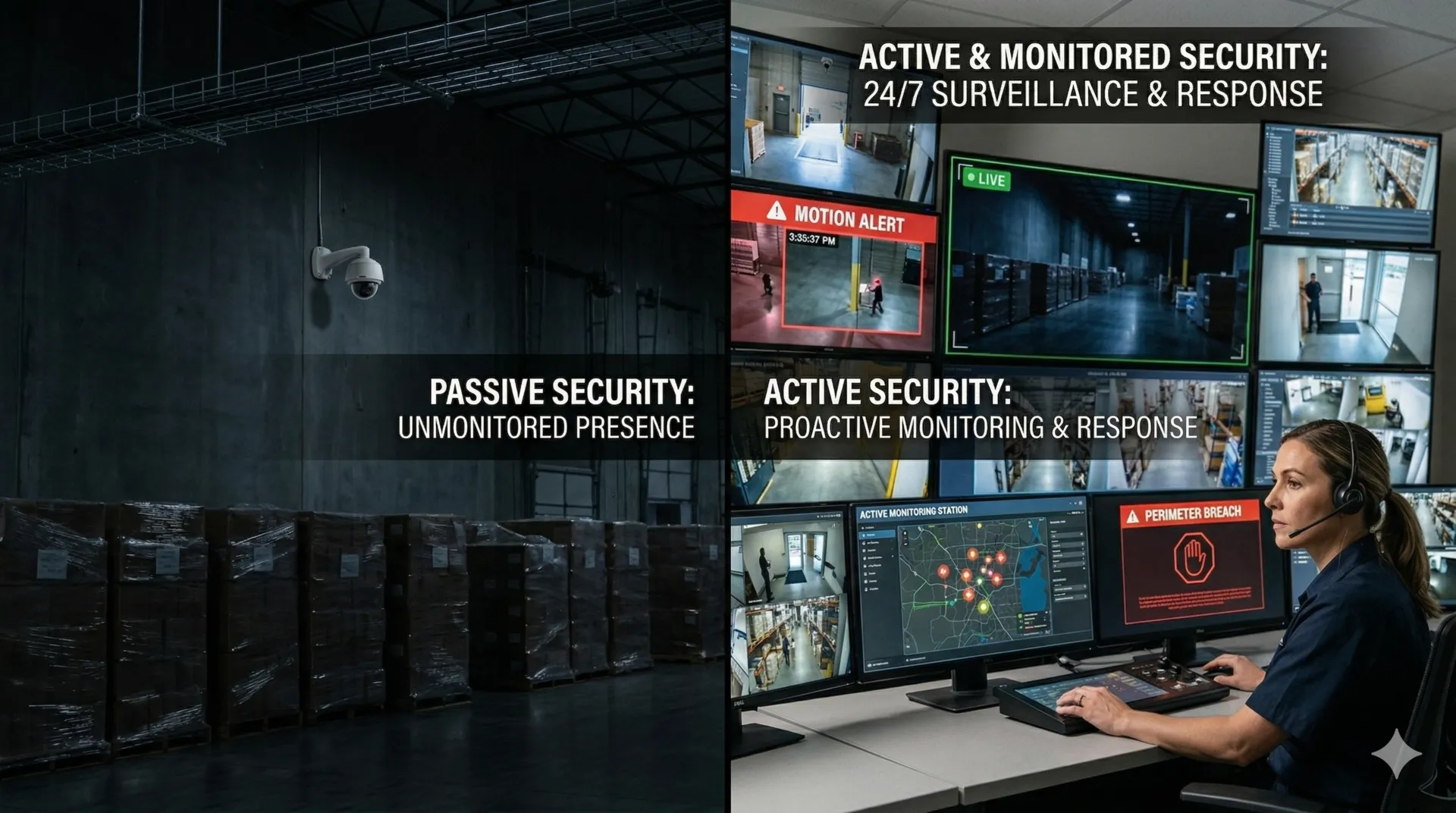
Cameras without monitoring are evidence collectors, not crime preventers. The footage helps with the insurance claim, but it doesn't stop the loss.
What you need: Live video monitoring. Trained operators watch your camera feeds during high-risk hours. When motion is detected after hours, the operator verifies the threat within seconds, activates a two-way audio warning, and dispatches police — all while the intruder is still on your property. Most incidents are resolved in under 60 seconds. The theft never happens.
2. High-Value Targets With Determined Thieves
If your business stores high-value inventory — electronics, pharmaceuticals, precious metals, luxury goods — cameras alone won't deter someone who has planned the job. Organized theft rings conduct surveillance, identify camera positions, wear disguises, and move fast. They know cameras are recording. They've calculated that they'll be gone before anyone reviews the footage.
For high-value targets, you need layers that slow down and physically impede the intruder — not just record them.
What you need: Security guards combined with cameras. A physical presence on-site changes the risk calculation entirely. Guards patrol, respond, and create unpredictability. Cameras give guards eyes across the entire property. Together, they're dramatically more effective than either one alone. For the highest-value situations, add live monitoring as a third layer — so the guard is directed to exactly where the threat is.
3. Internal Theft by Employees Who Know the Blind Spots
Employee theft accounts for roughly a third of all retail shrinkage in Canada. And employees have an advantage that external thieves don't: they know where the cameras are, what the blind spots are, and when nobody's reviewing footage. A warehouse worker who knows the camera doesn't cover the back corner of aisle 14 can walk out with product for months before anyone notices.
Cameras alone create an accountability problem: you know something is missing, but you can't prove who took it because the system has gaps that insiders exploit.
What you need: Access control combined with cameras. Card access on restricted areas (stockrooms, cages, high-value storage) creates a log of exactly who entered and when. Pair that with camera footage time-stamped to the same access events, and you have a complete accountability chain. When employees know that every door tap is logged and linked to video, theft drops dramatically — not because you caught someone, but because the system makes it obvious that they'd be caught.
4. Construction Sites With Changing Layouts
Construction sites are one of the hardest environments to secure. The layout changes weekly — new walls go up, equipment moves, staging areas shift. Fixed cameras installed in week one might be staring at a concrete wall by week four. And traditional wired cameras can't easily be relocated as the site evolves.
We've seen sites where the cameras were technically operational but covering areas that no longer mattered. Meanwhile, the new material staging area on the other side of the site was completely uncovered.
What you need: Relocatable camera systems with live monitoring. Rapid-deploy cameras mounted on portable poles with cellular connectivity can be moved in minutes as the site changes. Pair them with live monitoring, and operators are always watching the areas that matter right now — not where the equipment was three weeks ago. The monitoring provider adjusts coverage maps as the site evolves, keeping protection aligned with risk.
5. Compliance Environments — Healthcare, Finance, Legal
If your business operates under PHIPA (healthcare), financial industry regulations, or legal compliance requirements, cameras are only one piece of the puzzle. Regulators don't just want to know that you have video — they want documented proof of who accessed sensitive areas, when, and whether they were authorized.
A camera showing someone entering the records room is good. A card access log proving it was Dr. Smith at 2:14 PM on March 15th, cross-referenced with video confirming it was actually Dr. Smith (and not someone using her card), is what compliance requires.
What you need: Access control with audit logs, cameras with event-linked recording, and IT security measures. The access control system provides the who-and-when. Cameras provide visual verification. IT security (firewalls, encryption, endpoint protection) protects the digital records alongside the physical ones. For true compliance, these three layers need to work together as a unified system — not three separate products from three separate vendors.
The Bottom Line
We'll always tell you the truth about what cameras can and can't do. In many cases, a well-designed camera system is exactly what you need. But in these five situations, cameras alone leave gaps that cost real money. The right combination of security layers — tailored to your specific risk — is what actually protects your business.
Not sure what combination you need? Book a free security assessment. We'll walk your property, identify the risks, and recommend exactly what you need — nothing more, nothing less. Call us at (905) 550-0490.