Ontario auto body shops are bailers — they hold customer property under a legal relationship that creates specific liability. When a customer drops off a vehicle for repair, the shop takes on a duty of care for that vehicle from the moment of intake to the moment of return. Any damage that occurs while the vehicle is in the shop's custody is, by default, the shop's problem. Without documentation proving when the damage occurred, the shop's position in a dispute is weak — even if the damage was pre-existing, even if the customer is making a fraudulent claim.
This liability profile makes security documentation at auto body shops more than a standard commercial risk management exercise. It's the operational record that determines how damage disputes resolve. Ontario shops that understand this build their security systems around documentation at key transfer points. Shops that don't are funding a recurring, invisible loss from disputes they can't defend.
The Risk Profile for Ontario Auto Body Shops
Customer vehicle damage disputes. A customer picks up a repaired vehicle and claims new damage — a scratch on a panel that wasn't being repaired, a ding on a door, a cracked mirror. The shop's position depends entirely on what can be documented from the intake inspection. Without camera coverage of the intake area that captures vehicle condition at the time of drop-off, the shop is in a he-said-she-said situation. The easiest resolution is often to pay for the repair, regardless of fault.
Parts and tool theft. Body shops hold significant equipment value: frame straightening machines, welding equipment, paint booths, specialty tools, and parts inventory that may include expensive OEM components. After-hours break-ins targeting tool chests and parts inventory are common. A single incident can result in $20,000–$50,000 in equipment loss.
Customer vehicle theft. A vehicle in for repair — particularly a high-value vehicle or one with valuable aftermarket components — can be a theft target while in the shop's custody. The shop is responsible for it. A stolen vehicle in the shop's care is a worst-case liability event: the shop is on the hook for the vehicle's value plus any consequential losses the customer can document.
Insurance fraud staging. Body shops in Ontario have been used — sometimes knowingly, sometimes as unwitting participants — in insurance fraud schemes where vehicles are brought in for "repairs" to damage that was intentional or staged. A shop that doesn't document vehicle condition at intake can be implicated in a fraud claim it had no involvement in creating.
What Ontario Body Shops Get Wrong
No camera coverage of the intake and release area. This is the most consequential gap. The intake bay — where vehicles are accepted, conditions are noted, and the custody relationship begins — should have overhead camera coverage that captures the full exterior of the vehicle at the time of handover. The same coverage should be in place at the release area. Most Ontario body shops have a camera at the front door and cameras in the shop interior. The intake and release points are uncovered.
Written inspection reports without camera backup. A written condition report signed at intake is better than nothing. A written report signed by both parties, with timestamped camera footage confirming the vehicle's condition at the moment the report was created, is what makes a dispute resolvable. Fraudulent customers know that unsigned or poorly documented intake reports are easy to challenge.
No after-hours camera coverage of the lot. Customer vehicles parked outside after hours — either because the lot is full or because a customer will pick up after the shop closes — are often in areas with no camera coverage. A vehicle that is damaged or vandalized after hours, in a zone the shop's cameras don't reach, creates the same liability exposure as damage inside the shop.
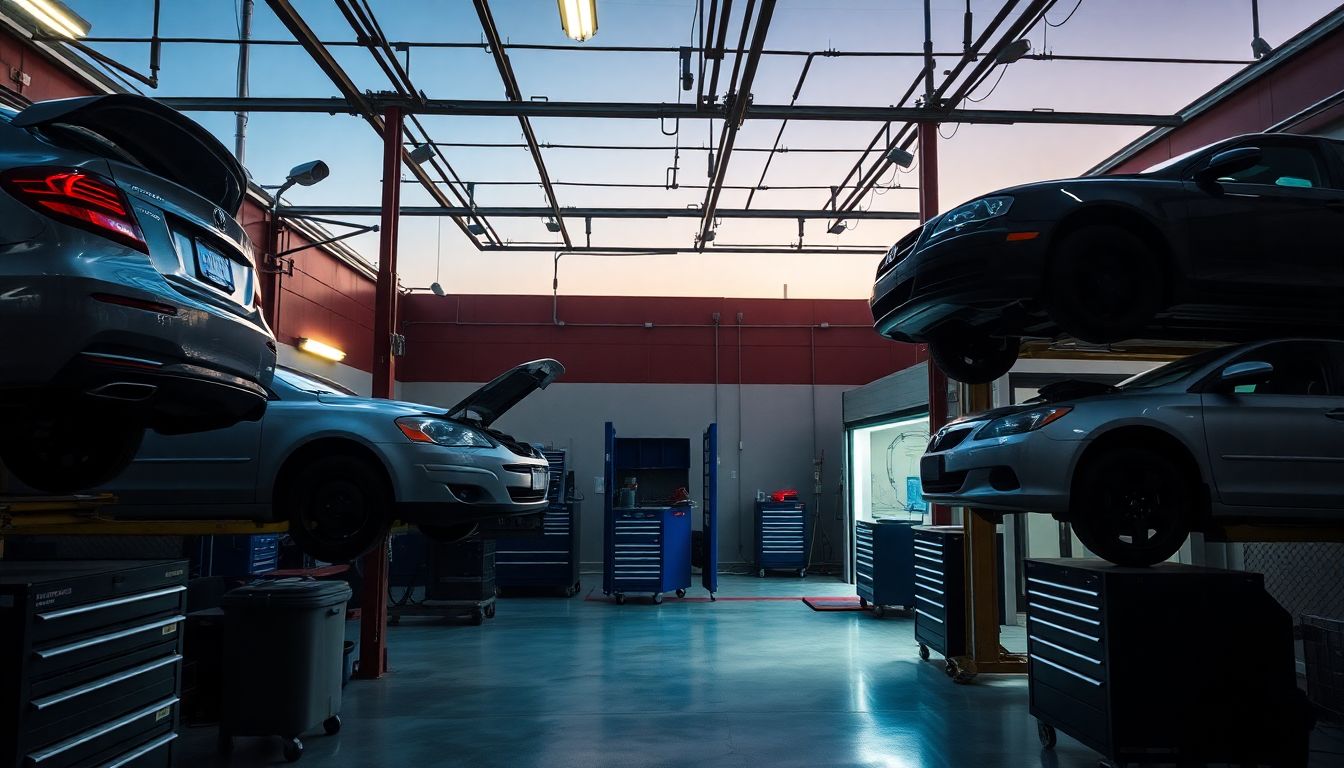
Inadequate after-hours security on the shop floor. The shop floor holds expensive equipment and tools in a large, often multi-bay space with multiple access points. After-hours intrusion detection on all access points — with camera-verified monitoring — is the appropriate security layer for this environment. Most Ontario body shops have a basic door alarm on the main entrance and nothing else.
No vehicle staging area coverage. Vehicles awaiting parts, waiting for a rental to be arranged, or in a "ready for pickup" queue often sit in a staging area for days. Camera coverage of this area — particularly the perimeter approach — documents any access to staged vehicles.
What Properly Secured Ontario Body Shops Look Like
Effective auto body shop security is built around documentation at custody transfer points and protection of the facility during non-business hours.
The intake area has overhead camera coverage — high enough to capture the full vehicle exterior, with adequate resolution to see panel-level condition. The release area has the same coverage. Footage retention is 90 days minimum — long enough that a customer who returns weeks after pickup claiming new damage still generates available footage from the intake date.
The shop floor has camera coverage of the tool and parts storage areas. Access to the tool room requires a credential. After-hours, motion on the shop floor triggers an alert to a monitoring station.
All vehicle access points — the main shop door, the service entrance, the rear bay doors — have monitored contacts. An unauthorized opening after hours generates an immediate response, not a morning review.
The vehicle lot — including the customer drop-off area, the in-progress vehicle area, and the ready-for-pickup staging — has camera coverage. Vehicles parked outside after hours are in-coverage zones.
The operating principle is simple: any point at which vehicle custody changes hands, or at which the vehicle is present and unattended, should be documented. The cost of a comprehensive camera deployment at an auto body shop is a fraction of a single undefended damage dispute at a high-value vehicle.
For a detailed breakdown of security systems designed for Ontario auto body shops, see our auto body shop security page.