Restaurant industry research consistently finds that the majority of theft losses in food service come from internal sources — employees, not external shoplifters or after-hours break-ins. Estimates across the industry suggest that somewhere between 75% and 85% of restaurant theft is internal. In a margin business where net profit often runs 3–9% of revenue, internal theft that represents even 1–2% of revenue can be the difference between a viable operation and an unsustainable one.
The challenge for Ontario restaurant owners is that internal theft in a food service environment takes forms that aren't visible in standard shrink reports. No inventory category is obviously missing. The cash register reconciles within a reasonable variance. The pour cost is elevated but within the range that gets attributed to waste. The losses are real, systematic, and invisible to the standard reporting structures most operators rely on.
How Internal Restaurant Theft Actually Works
Register skimming. A server rings in an order, collects cash payment, and voids the transaction — or simply doesn't ring it at all. The cash goes into the drawer and comes out at the end of the shift. In a busy full-service restaurant with cash transactions, a single server doing this consistently across a shift can skim $50–$150 without triggering obvious variances. The key enabler is that the transaction never permanently existed in the POS system.
Void and discount abuse. Access to void or discount functions — intended for legitimate corrections and manager-approved comps — creates a mechanism for theft. A server or cashier applies an unauthorized void or discount after cash has been collected, and keeps the difference. Without camera coverage of the POS display at the time of the transaction, distinguishing legitimate voids from fraudulent ones requires detailed POS audit work that most operators don't do regularly.
Bar theft. The bar is the highest-theft area in any restaurant with a liquor licence. Pouring without ringing — giving a drink to a friend, pouring a double and ringing a single, free-pouring over the measured count and pocketing the difference — are all forms of bar theft that inflate pour cost without a traceable inventory discrepancy. A bartender who consistently over-pours is raising your cost of goods. A bartender who under-rings is stealing cash.
Walk-out facilitation. A server who fails to stop a "dine and dash" that involved a table of their friends is facilitating a loss, not reporting a customer incident. In restaurants without camera coverage of the dining room and exit, this is difficult to document or distinguish from an actual unexpected walkout.
Food and supply theft. Kitchen staff with access to the walk-in and dry storage area — and to the building exits — can walk product out in bags, in uniform pockets, or through arranged "supplier pick-up" schemes. A cook who takes home a case of proteins per week is costing the operation money that shows up as elevated food cost with no obvious explanation.
What Ontario Restaurant Camera Systems Miss
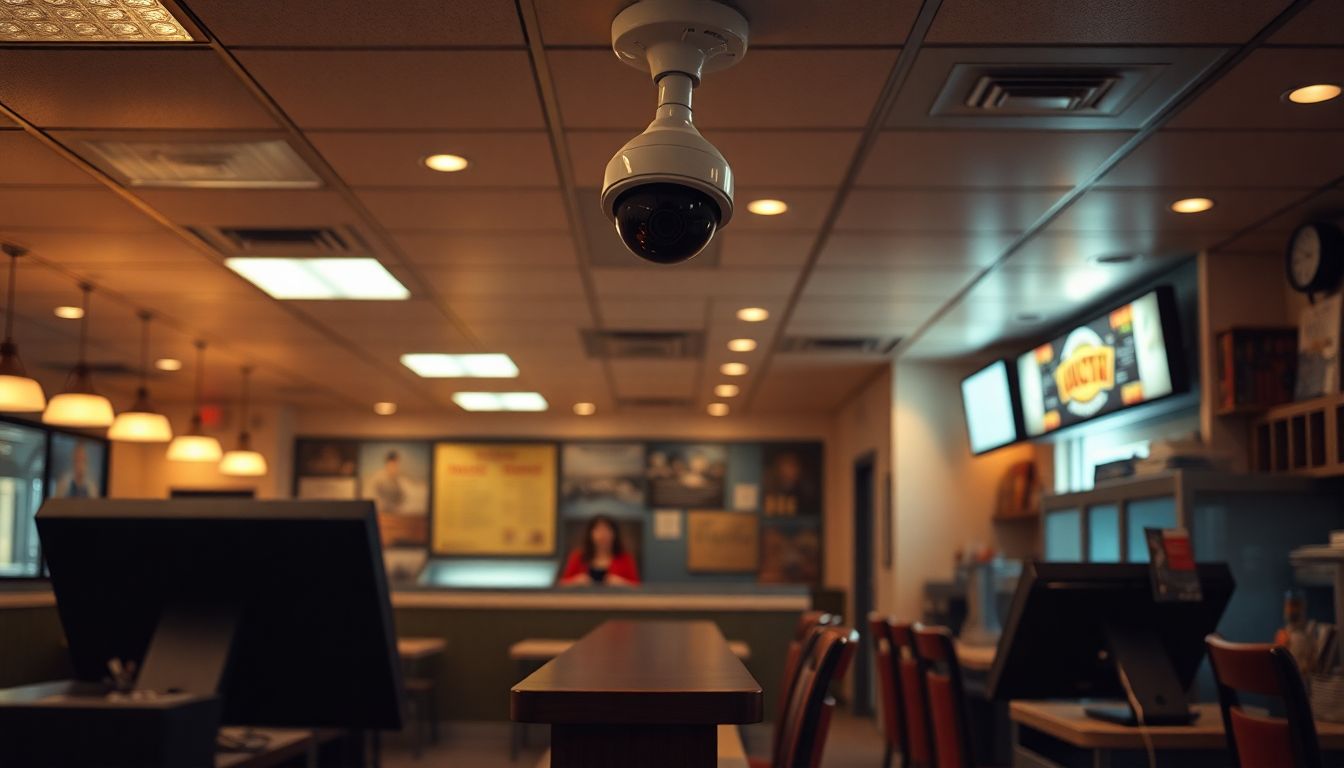
The POS display. The most critical camera position in any restaurant is one that captures the register display and the employee's hands during a transaction. Most restaurant camera systems have a camera somewhere in the area of the bar or the front of house — but not positioned to capture what is actually being entered into the POS system. Without this, the camera documents that a transaction happened, but not what was rung.
The bar well. A camera covering the bar from a patron-facing angle captures customer interactions but not the pour count or the register screen. A camera positioned to capture the bar well from behind — seeing both the bottles being used and the POS interactions — is what makes bar theft visible. Most restaurant installations don't have this.
Walk-in and dry storage exits. A camera covering the door to the walk-in cooler and the door to dry storage — plus the back-of-house exit — documents who is removing what from the building. Most restaurant kitchens have no camera coverage at all.
The back door. The back-of-house exit is one of the most important camera positions in a restaurant. Product that walks out the back door, waste disposal that becomes a theft channel, and unauthorized individuals entering the kitchen are all documented only by a camera covering this exit.
What Properly Secured Ontario Restaurants Look Like
Effective restaurant security starts with POS-integrated coverage. A camera at the register or POS terminal captures the display and the employee at the moment of every transaction. Combined with POS audit reports that flag void frequency, discount usage, and cash-tender transactions by employee, this creates accountability that makes systematic theft extremely difficult to sustain.
The bar has a camera covering the well and the POS interaction point. Bar staff know the coverage exists and that pour counts can be reviewed against transaction records.
The kitchen has camera coverage at the walk-in and dry storage exits and at the back-of-house door. Access to inventory storage is logged. Supplies leaving the building are documented.
The dining room has sufficient camera coverage to document table service, payment interactions, and exits. Walk-outs and comps can be reviewed against the table's POS record.
These measures don't create a hostile work environment — they create the same accountability that exists in every well-managed retail operation. Most employees are honest. Camera systems protect them as much as they protect the owner, by making it impossible for a dishonest colleague's behaviour to be attributed to the team as a whole.
For a detailed breakdown of security systems designed for Ontario restaurants, see our restaurant security page.