Self-storage facilities in Ontario present a security challenge that looks simpler than it is. The premise is straightforward — a customer rents a unit, puts their property in it, and expects it to be there when they return. The operator's legal relationship with stored property creates a duty of care that makes security failures costly: in Ontario, an operator who is found to have failed to provide reasonable security can be liable for stored goods losses.
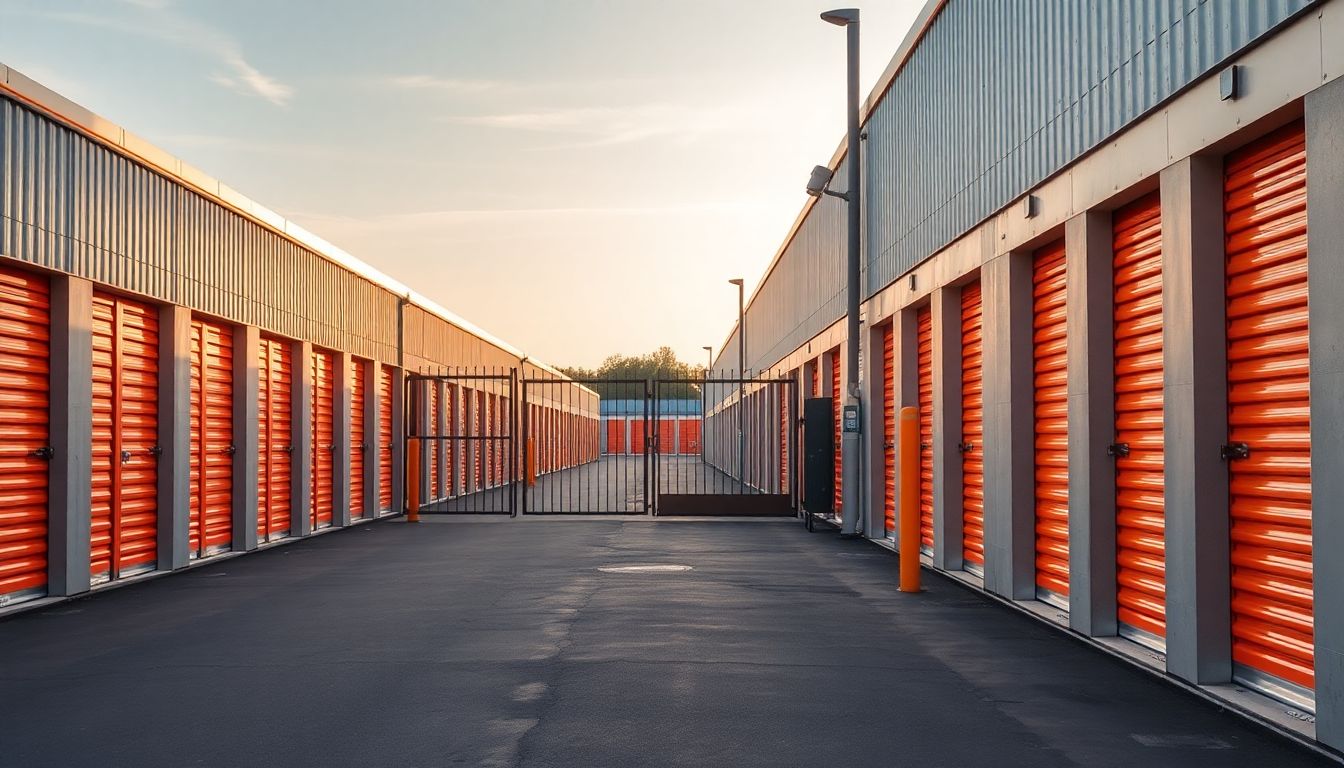
What complicates the picture is scale. A typical Ontario self-storage facility has 200–600 units across multiple buildings, a large parking and access area, and a business model that requires after-hours customer access. The combination of large property, valuable stored contents, and regular legitimate after-hours access creates a profile that experienced theft groups have learned to exploit.
How Self-Storage Break-Ins Work in Ontario
Unit lock drilling and cutting. The most common self-storage break-in method is direct attack on the unit lock — cutting the hasp or drilling the lock cylinder. This takes 60–90 seconds on most disc locks and is nearly silent. In a facility without camera coverage of unit doors and without intrusion detection inside the building, it goes undetected until a customer visits the unit.
Perimeter access. Many Ontario self-storage facilities have powered gate access for the vehicle entrance. The pedestrian perimeter — the fence surrounding the unit buildings — is often less well secured. Entry through a fence gap, over a low fence section, or through a pedestrian entrance that isn't on the same access control system as the vehicle gate allows access without triggering any entry log.
Tailgating through the main gate. The most common access method for opportunistic theft isn't defeating the fence — it's following a legitimate customer through the powered gate. A vehicle that tailgates through the gate immediately after a customer entering creates no access control record, because the gate opened for the customer, not the following vehicle. Without camera capture of the gate approach that distinguishes single-vehicle entry from tailgating, this happens invisibly.
Inside jobs. Facilities with long-term staff, particularly facilities where the same person manages access control and security, have an insider risk. A staff member who knows which units hold high-value property — through customer conversations, unit size patterns, or observed move-in activity — has information that is valuable to external theft rings.
Common Security Gaps at Ontario Self-Storage Facilities
Camera coverage of the facility entrance but not unit aisles. A camera at the main gate and one over the office entrance covers legitimate access. It doesn't cover the unit aisles — where the actual break-in occurs. Camera coverage of unit aisles, positioned to capture activity at unit doors, is the single most important gap in most Ontario self-storage security deployments.
No after-hours intrusion detection inside the buildings. The powered gate means the vehicle entrance logs after-hours entry. The area inside the fence — the unit buildings, unit aisles, and storage corridors — is frequently without intrusion detection. A person who is inside the perimeter has no barrier to accessing any unit in the facility.
Gate access that doesn't capture tailgating. Access control logs who opened the gate but not how many vehicles entered. Without a camera covering the gate approach — positioned to capture the full gate cycle and any following vehicles — the access log shows legitimate entries but misses the tailgating pattern that is the most common unauthorized access method.
No after-hours monitoring. Self-storage facilities in Ontario almost universally offer 24-hour or extended customer access. Without live monitoring or motion-triggered alert capability during the overnight window, an unauthorized visitor inside the perimeter has no detection risk. Recording cameras capture the incident; monitoring prevents it.
Insufficient lighting in unit aisles. Motion-activated or dawn-to-dusk lighting in unit aisles is common. LED lighting that only activates on motion can create dark windows between customer visits that are useful to someone working quickly on a unit lock. Consistent aisle lighting during evening and overnight hours is both a deterrent and a camera performance requirement.
What a Properly Secured Ontario Self-Storage Facility Looks Like
Effective self-storage security is built around the access control boundary and the unit aisle coverage.
The vehicle gate has a camera positioned to capture both the vehicle entering and any vehicles following. The access control system logs every credential-based entry and exit. A gate that opens for one credential does not create a record for a following vehicle — but a camera that captures the gate cycle from the correct angle does.
Pedestrian perimeter access is on the same access control system as the vehicle gate. No one enters the unit area through a pedestrian entrance without a logged credential. Perimeter camera coverage confirms no unauthorized fence crossing.
Inside the facility, camera coverage is distributed along unit aisles — not just at building entrances. Cameras are positioned to capture activity at unit door level. After-hours motion in the aisle area triggers an alert to a monitoring station.
The office and gate control system are covered by a separate alarm zone. After-hours access to the office triggers an immediate high-priority alert.
Unit aisle lighting is consistent and adequate for camera performance throughout the access hours window. Lighting levels are high enough to capture identifying detail on camera.
Self-storage customers trust that their property is safe. The facilities with the worst theft histories are consistently the ones with visible coverage gaps — facilities where an experienced thief can spend five minutes driving through before choosing a unit and knowing there's no response risk. The ones that are passed over are the ones where coverage is comprehensive enough to make the risk calculation unfavorable.
For a detailed breakdown of security systems designed for Ontario self-storage facilities, see our self-storage security page.