We install cameras for a living. We've worked with every major commercial brand, in every type of environment — from small retail shops to sprawling industrial yards. We don't sell one brand exclusively, which means we don't have a financial incentive to recommend one manufacturer over another. What follows is our honest assessment of what works, what doesn't, and what you should look for when choosing a commercial camera system for your Ontario business in 2026.
Camera Types: When Each Excels
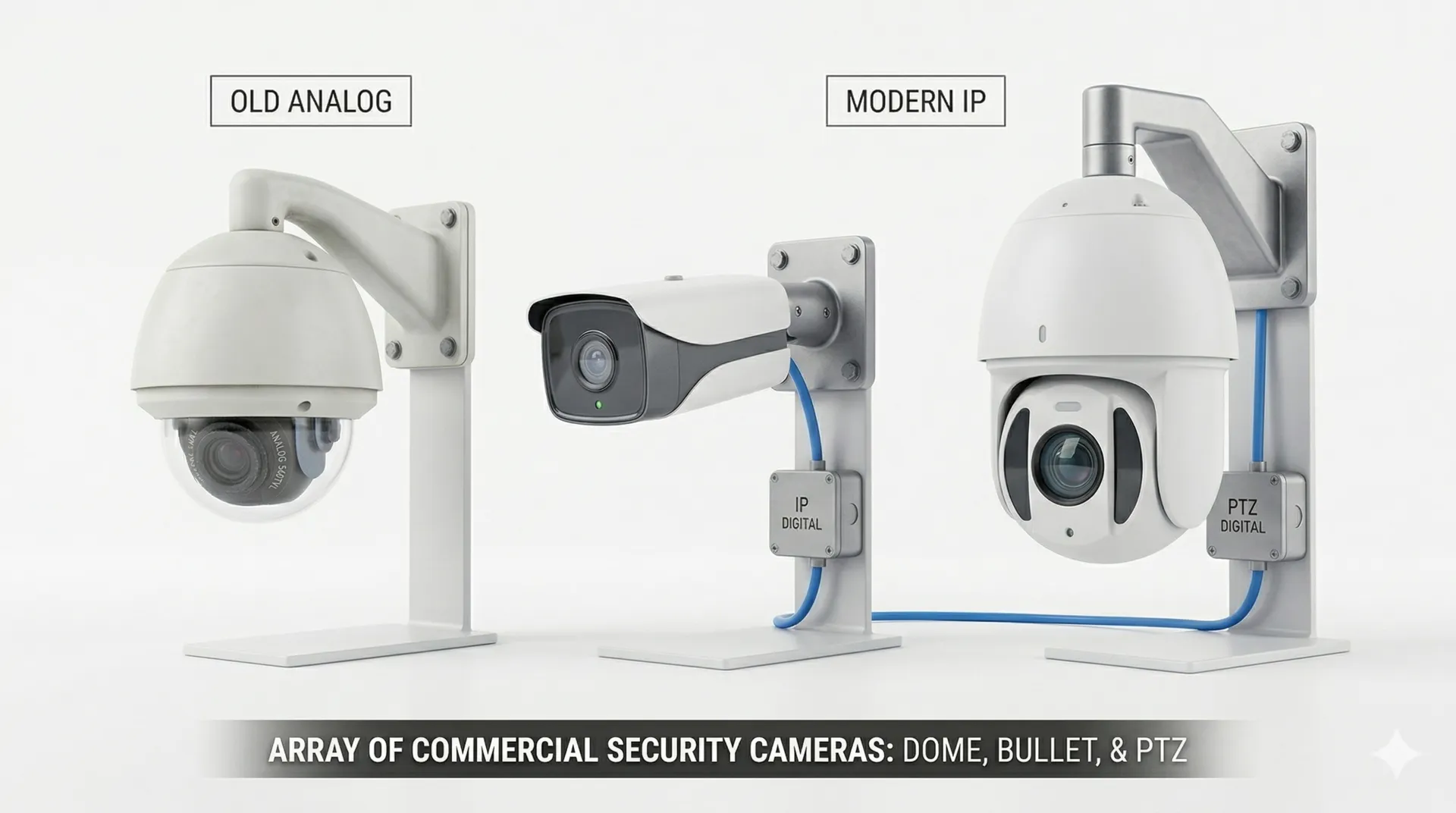
Before diving into specs and brands, you need to understand the three main camera form factors and where each one belongs. Choosing the wrong type for your environment is one of the most common and costly mistakes.
Dome Cameras
Dome cameras sit in a compact, rounded housing — usually ceiling-mounted or mounted under an eave. They're the most common commercial camera type for good reason:
- Discreet profile: Domes don't scream "security camera." In retail, offices, and customer-facing environments, that matters. They monitor without making people feel surveilled.
- Vandal-resistant: The dome housing is typically IK10-rated (impact resistant). You can't easily grab, twist, or redirect a dome camera the way you can a bullet. In parking garages, stairwells, and public-facing areas, this is a real consideration.
- Wide-angle coverage: Domes are excellent for covering broad interior spaces — lobbies, warehouse floors, open-plan offices, and retail sales floors.
- Limitations: Domes generally have shorter effective range than bullet cameras due to their wider field of view. For long-distance identification (reading a plate at 30 metres), a dome usually isn't the right choice.
Best for: Retail interiors, offices, lobbies, hallways, warehouses (ceiling-mounted for wide coverage), and any location where aesthetics and vandal resistance matter.
Bullet Cameras
Bullet cameras are the cylindrical, wall-mounted cameras you see pointed at entrances, loading docks, and parking lots. They're built for targeted, long-range coverage:
- Long-range identification: Bullet cameras with varifocal or motorized zoom lenses can capture readable licence plates at 25–40 metres and identifiable faces at 15–25 metres. Their narrow, focused field of view concentrates resolution where it matters.
- Visible deterrence: Unlike domes, bullets are obviously cameras. That visibility serves as a deterrent — people behave differently when they can clearly see a camera pointed at them.
- Weather resistance: Bullet housings with integrated sun shields handle direct sunlight, rain, and snow better than most dome housings. The extended barrel protects the lens from precipitation and glare.
- Limitations: Bullets are easier to physically redirect (someone can push the barrel to change the viewing angle). They also have a narrower field of view than domes, which means you need more of them to cover wide areas.
Best for: Building entrances, loading docks, parking lot perimeters, gate approaches, and any location where long-range identification is the priority.
PTZ Cameras (Pan-Tilt-Zoom)
PTZ cameras can rotate horizontally, tilt vertically, and zoom in with optical magnification — typically 25x to 40x. They're the most versatile and most expensive camera type:
- Active tracking: Modern PTZ cameras with AI analytics can automatically track a person or vehicle as they move through the scene, keeping them centred in frame and zoomed in for identification.
- Massive coverage: A single PTZ can cover the area that would require 4–6 fixed cameras, rotating between preset positions on a patrol tour.
- Live monitoring essential: PTZ cameras deliver their best value when paired with live monitoring operators who can take manual control, zoom into suspicious activity, and follow subjects in real-time. Without monitoring, a PTZ is just an expensive fixed camera that happens to look in different directions every few seconds.
- Limitations: A PTZ can only look in one direction at a time. While it's zoomed in on the north gate, the south fence is unmonitored. PTZ cameras should always be supplemented with fixed cameras that provide continuous baseline coverage while the PTZ focuses on active events.
Best for: Large outdoor yards, parking lots, perimeter monitoring, and any site with live video monitoring service. Not ideal as a standalone — always pair with fixed cameras.
What to Look For: Non-Negotiable Specs for Ontario
Ontario's climate and commercial environment demand specific specifications. Here's what we consider the minimum for any commercial installation in 2026:
| Specification | Minimum Requirement | Why It Matters | |---|---|---| | Resolution | 4K (8MP) minimum | Anything less and you lose detail at distance. 4K is the baseline for evidence-quality footage in 2026. | | Weather rating | IP67 or higher | IP67 means fully dust-tight and submersible in 1 metre of water. Ontario gets driving rain, heavy snow, and ice — anything less than IP67 will fail. | | Operating temperature | −40°C to +60°C | Southern Ontario regularly hits −25°C. Northern Ontario goes well below −30°C. Cameras rated to only −20°C will die in a cold snap. | | Compression | H.265 (HEVC) | H.265 uses roughly half the storage and bandwidth of H.264 at the same quality. For 4K cameras, H.265 is essential to keep NVR storage and network bandwidth manageable. | | Power | PoE (802.3af/at) | Power over Ethernet means one Cat6 cable carries both video and power. No separate power supplies, no electrician running outlets to every camera location. Simpler, cheaper, more reliable. | | Compatibility | ONVIF Profile S/T | ONVIF is the open standard that ensures cameras work with NVRs and software from different manufacturers. Without ONVIF, you're locked into one vendor's ecosystem forever. |
Any camera that doesn't meet all six of these specifications shouldn't be installed in a commercial environment in Ontario. Period.
Recommendations by Environment
Different commercial environments have different priorities. Here's what we install most often in each setting, based on what actually performs well over years of real-world use.
Warehouses and Distribution Centres
Warehouses need wide interior coverage with enough resolution to identify people and read labels on packages from 15+ metres. The main challenges are large open spaces, high ceilings, varying lighting conditions, and busy loading dock areas.
- Interior: 4K dome cameras with wide-angle lenses (2.8mm or varifocal 2.8–12mm), ceiling-mounted at 4–6 metre height. Domes provide broad coverage of aisles and open floor space. WDR (Wide Dynamic Range) is important for handling the contrast between bright dock doors and dim interior aisles.
- Loading docks: 4K bullet cameras with varifocal lenses, focused on each dock door and the staging area in front of it. These need to capture plate numbers on trucks backing into the dock and identify anyone handling cargo.
- Exterior: Starlight bullet cameras along the perimeter, aimed at fence lines and building approaches. PTZ at main entry gates if the site has live monitoring.
Typical system: 16–32 cameras depending on square footage. Budget: $15,000–$40,000 installed including NVR.
Outdoor Yards (Truck, Equipment, Storage)
Outdoor yards are high-risk environments with large open areas, limited lighting, and valuable assets sitting exposed overnight. Night vision performance is the number one priority.
- Perimeter: Starlight bullet cameras every 20–30 metres along the fence line, providing overlapping coverage with no gaps. These must deliver usable colour footage in near-darkness.
- Gates: Dedicated 4K bullet cameras with LPR-optimized lenses at every vehicle entry and exit point. Narrow field of view focused on the lane to maximize plate capture accuracy.
- Central coverage: Starlight PTZ cameras on 6+ metre poles, covering the interior yard space. Auto-tracking enabled for live monitoring operators to follow subjects of interest.
Typical system: 12–24 cameras. Budget: $20,000–$50,000 installed, plus monitoring service.
Retail Stores
Retail environments balance security with customer experience. Cameras need to cover the sales floor, cash registers, entrances, and back rooms without creating an oppressive atmosphere.
- Sales floor: Compact 4K dome cameras, ceiling-mounted for discreet wide-angle coverage. White or black housing to match the ceiling — appearance matters in customer-facing spaces.
- Cash registers: Dedicated dome cameras with narrow fields of view, aimed directly at the transaction area. These capture hand movements and till activity for loss prevention.
- Entrance: Bullet or dome camera at every entry/exit, positioned to capture clear facial images of everyone entering the store. This is the most important camera in any retail system — if you can identify who walked in, you can identify who walked out with your merchandise.
- Back of house: Basic dome cameras in stockrooms, receiving areas, and back exits. These don't need to be as high-spec as customer-facing cameras.
Typical system: 8–16 cameras. Budget: $8,000–$20,000 installed.
Offices and Commercial Buildings
Office environments typically need less aggressive coverage than warehouses or yards. The priorities are access control verification, common area monitoring, and after-hours intrusion detection.
- Lobbies and reception: Compact 4K dome cameras that blend with the ceiling and cover the entrance and reception desk.
- Hallways and common areas: Wide-angle dome cameras at corridor intersections. Every hallway doesn't need a camera — focus on chokepoints where all traffic passes.
- Parking garage: Starlight dome cameras rated for the temperature range (garages swing from extreme heat in summer to well below freezing in winter). WDR is critical for handling the contrast between dark interior and bright entrance.
- Server rooms and restricted areas: Dedicated cameras covering the door and interior. These often integrate with the access control system to provide video verification of every card swipe.
Typical system: 8–16 cameras. Budget: $8,000–$18,000 installed.
A Note on Brands
We deliberately avoid recommending specific brands in this guide because the commercial camera market shifts constantly — models change, firmware improves or regresses, and pricing fluctuates. What we care about is whether a camera meets the spec requirements above and performs reliably in the field over years of real-world use. We work with multiple commercial-grade manufacturers and select the best option for each project based on the environment, budget, and integration requirements.
What we don't install: consumer brands (Ring, Arlo, Nest) or ultra-budget no-name imports. These products have their place in residential applications but they don't meet the durability, resolution, or integration requirements of commercial environments in Ontario.
Get a System Designed for Your Environment
The "best" camera system is the one designed specifically for your property, your risk profile, and your budget. A truck yard needs a completely different system than a dental office. A retail store has different priorities than a construction site. Generic recommendations only get you so far — what you need is a site-specific design from someone who's installed hundreds of commercial systems.
We offer free site surveys for commercial properties across Ontario. We'll walk your property, identify coverage requirements, and provide a detailed proposal with camera types, positions, and pricing — no obligation. Call us at (905) 550-0490) or visit our security camera page to get started.