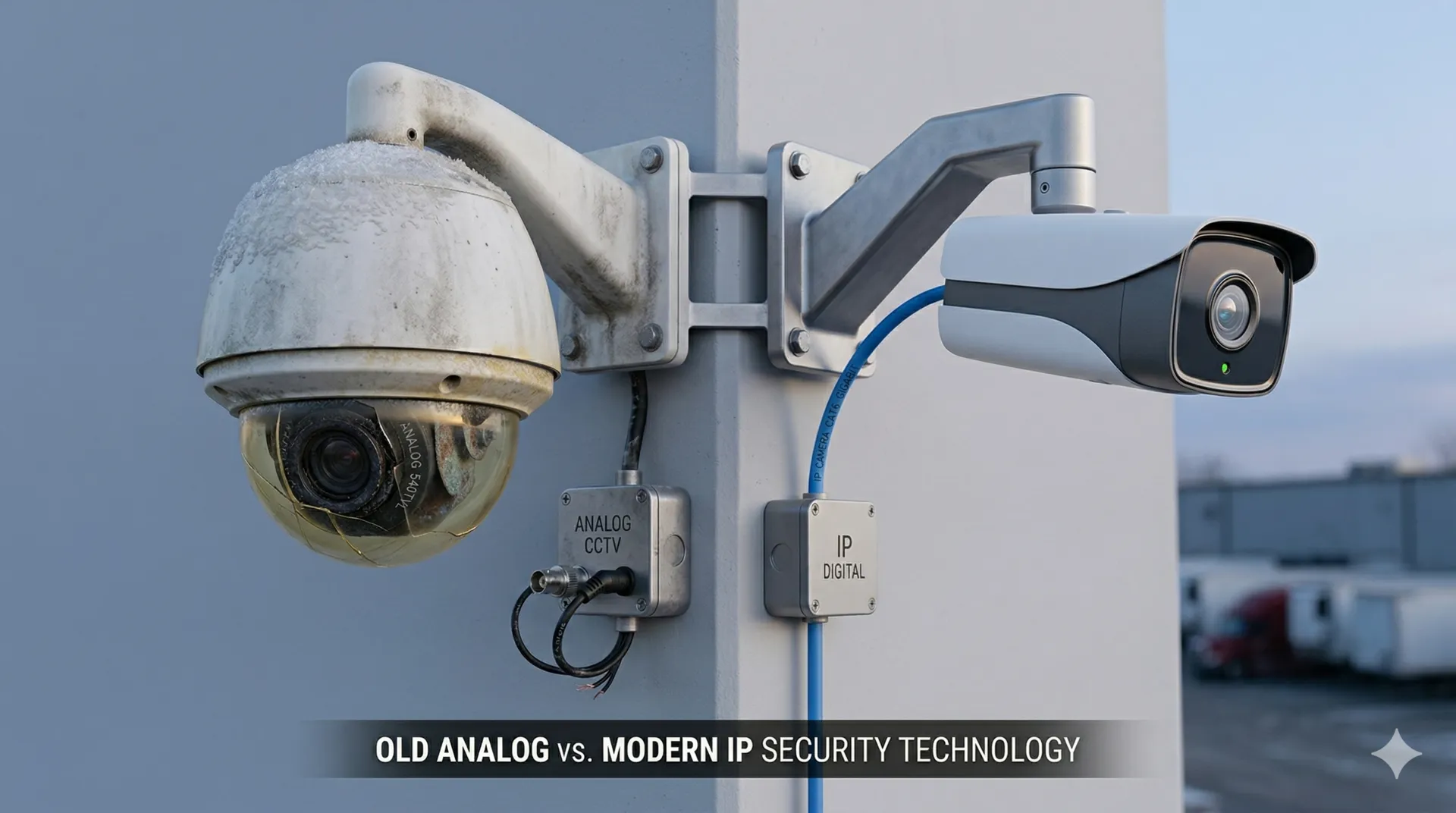
This is one of the most common questions we get from business owners upgrading their security systems or installing cameras for the first time. Analog CCTV has been around for decades and it still works. IP cameras are newer, more capable, and increasingly affordable. So which should you install in 2026? Here's the honest, side-by-side comparison.
The Full Comparison
| Feature | Analog CCTV | IP Cameras | |---|---|---| | Resolution | 720p / 1080p max | 1080p to 4K+ (up to 12MP) | | Cabling | BNC coax + separate power | Cat6 Ethernet (PoE — one cable for video + power) | | Scalability | Limited by DVR channels and coax runs | Add cameras to any PoE switch port on the network | | Remote Access | Limited — often laggy, low resolution | Full HD/4K streaming from any device, anywhere | | Analytics | None — records video only | AI-powered: motion detection, line crossing, object classification, people counting, licence plate recognition | | Audio | Rarely supported | Built-in microphone and speaker on most models | | Upfront Cost | Lower — $100–$200/camera | Higher — $200–$700/camera | | Long-Term Cost | Higher — limited lifespan, no upgrade path | Lower — firmware updates, expandable, longer useful life | | Future-Proofing | Dead-end — analog is a declining standard | Expandable — integrates with access control, monitoring, analytics platforms |
Where Analog Still Makes Sense
We're not going to pretend analog is useless — there are a few scenarios where it's still a reasonable choice:
- Very small sites on a tight budget: A 2–4 camera system for a small shop where the owner just wants basic visual coverage and isn't concerned about licence plates or remote viewing. Analog can get you recording for under $1,500.
- Replacing cameras on existing coax: If your building already has coax cabling run to every camera position and your budget doesn't allow re-cabling, HD-over-coax cameras (HD-TVI, HD-CVI) can deliver 1080p over your existing wiring. This avoids the cost of pulling new Cat6 to every location.
- Supplementary cameras in low-priority areas: Adding a cheap analog camera to cover a back hallway that just needs basic motion recording — not evidence-quality footage — can be cost-effective on a hybrid system.
Beyond these edge cases, analog is increasingly hard to justify for any new commercial installation.
Where IP Wins — Which Is Almost Everywhere Else
Evidence quality: The gap between 1080p analog and 4K IP is enormous in practice. A 4K IP camera captures readable licence plates at 25+ metres and identifiable facial features at 15+ metres. Analog at the same distances gives you blurry shapes that police can't use. When footage needs to serve as evidence, resolution is everything.
Remote access: IP cameras stream full-resolution video to your phone, tablet, or desktop from anywhere with internet. You can check on your property from home, on vacation, or from another job site. Analog remote access exists but it's typically laggy, low-resolution, and unreliable.
Smart analytics: This is the biggest differentiator in 2026. Modern IP cameras run on-board AI analytics — they can distinguish between a person, a vehicle, and an animal. They can trigger alerts only when someone crosses a defined boundary or enters a restricted zone. They can count people, read licence plates, and detect loitering. Analog cameras do none of this. They just record.
Integration: IP cameras live on your network, which means they integrate with access control systems, alarm panels, live monitoring services, and building management platforms. A unified security ecosystem — where your cameras, door locks, and alarms talk to each other — is only possible with IP.
Scalability: Need to add three cameras next year? With IP, you plug them into available PoE switch ports and configure them on the NVR. With analog, you need to run new coax from each camera position back to the DVR and hope you have open channels. IP scales incrementally; analog scales painfully.
Our Recommendation for 2026
For any new commercial installation, we recommend IP cameras in virtually every case. The upfront premium over analog has shrunk significantly — a quality 4K IP camera now costs $300–$500, compared to $150–$250 for a comparable analog unit. That $150–$250 difference per camera buys you dramatically better resolution, full remote access, smart analytics, and a system that will remain current for 7–10 years.
The only exception: if you have existing coax infrastructure, a very tight budget, and minimal requirements, HD-over-coax can serve as a bridge solution until you're ready to invest in a full IP system. But understand that it's a stopgap, not a long-term strategy.
If you're currently running analog and wondering whether it's time to switch, the answer is almost certainly yes — and hybrid NVRs make it possible to migrate incrementally, replacing analog cameras with IP units one at a time while using the same recorder.
Ready to Upgrade?
We'll assess your current system, evaluate your existing cabling, and design an IP upgrade path that fits your budget — whether that's a full replacement or a phased migration. Call us at (905) 550-0490) or use the contact form to book a free site survey.