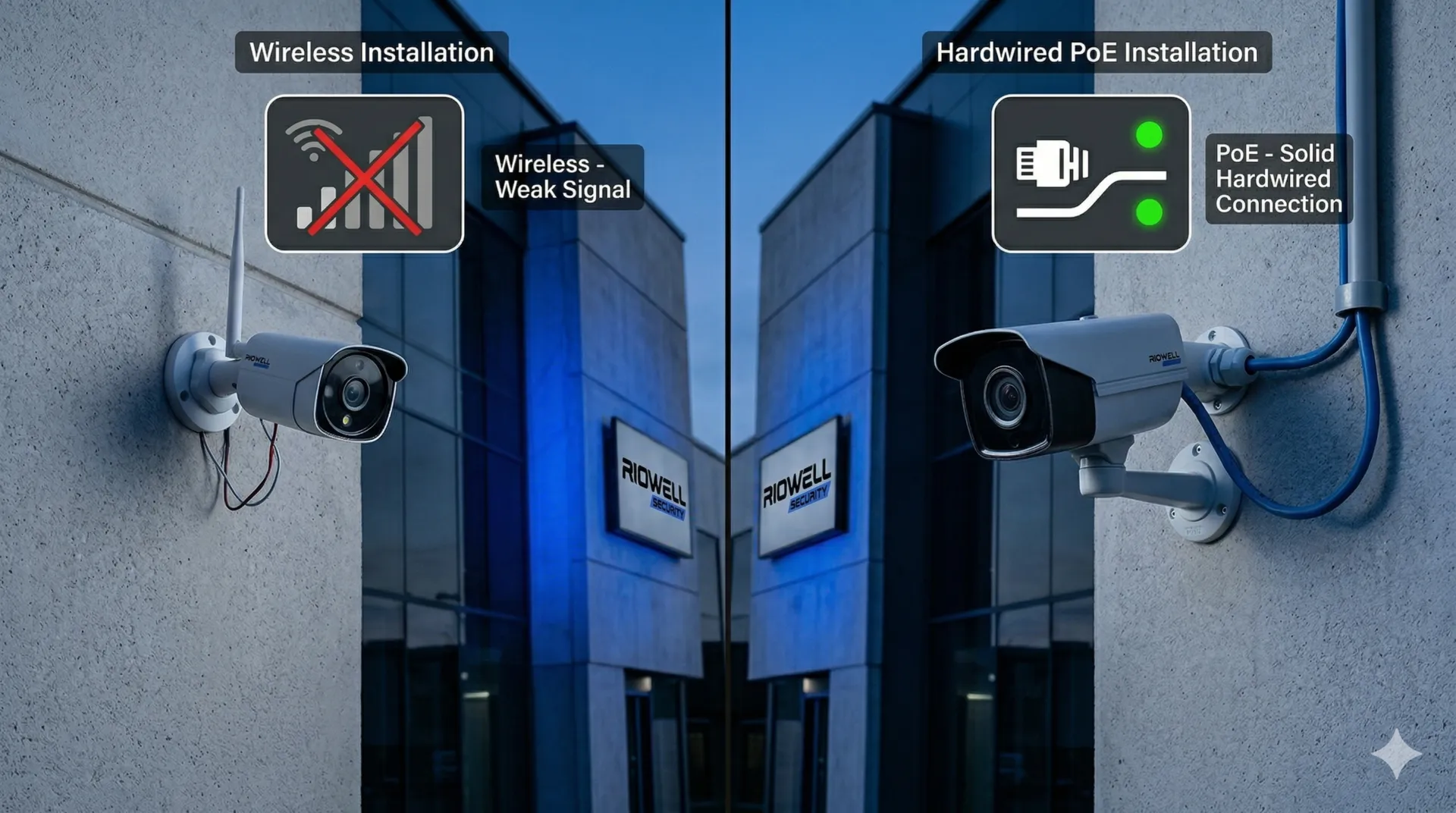
Wireless security cameras have become incredibly popular in the residential market, and it's easy to see why — no cables to run, quick setup, and sleek hardware. But when business owners ask us about installing wireless cameras for their commercial property, we give them the honest answer: wireless has a role, but it's a narrow one. For permanent commercial installations, hardwired PoE cameras are better in almost every way that matters.
When Wireless Cameras Actually Make Sense
Before we get into the limitations, let's be clear about when wireless cameras are a legitimate choice:
- Construction sites: Temporary sites where you need cameras for 3–12 months and there's no network infrastructure. Cellular-connected wireless cameras on portable poles are the standard solution here, and they work well.
- Temporary monitoring: Event venues, pop-up retail locations, seasonal operations, or short-term lease spaces where running cable isn't justified.
- Proof of concept: You want to test camera angles and coverage before committing to a permanent hardwired installation. Wireless lets you experiment without drilling holes.
- Remote locations without power or internet: Solar-powered cellular cameras are the only realistic option for monitoring remote equipment yards, rural properties, or unmanned facilities without utility services.
In all of these cases, the temporary or infrastructure-limited nature of the deployment makes wireless the right tool. The problems start when people try to use wireless cameras as permanent fixtures in commercial environments.
Why Wireless Fails for Permanent Commercial Installs
Bandwidth Limitations
A single 4K security camera streaming continuously uses 8–16 Mbps of bandwidth, depending on the compression and frame rate. Put four wireless cameras on the same Wi-Fi access point and you're consuming 32–64 Mbps of wireless bandwidth — and that's under ideal conditions. In a real commercial environment where employees are also using Wi-Fi for laptops, phones, point-of-sale systems, and IoT devices, that camera traffic creates congestion that degrades everything on the network. We've seen businesses where adding wireless cameras caused their payment terminals to time out during peak hours.
Interference in Commercial Environments
Wi-Fi signals don't travel well through metal, concrete, or heavy machinery. Warehouses with metal shelving, manufacturing floors with steel equipment, and commercial kitchens with stainless steel surfaces are particularly hostile environments for Wi-Fi. The signal that works perfectly during an empty-building test drops to unusable levels when the shelves are stocked with product and forklifts are moving. We've been called to troubleshoot wireless camera systems in warehouses where cameras would work fine overnight and then lose connection every morning when operations started.
Battery Maintenance
Battery-powered wireless cameras need to be recharged or have their batteries swapped every 2–8 weeks depending on activity levels. For a camera mounted at ceiling height in a warehouse, that means someone is climbing a ladder every month. Multiply that by 8 or 12 cameras and you have a maintenance burden that never ends. It's not a question of if the battery dies at the worst possible moment — it's when. And when it happens at 2 AM on a Saturday, that camera is offline until Monday.
Security Vulnerabilities
Wireless cameras communicate over Wi-Fi, which means they're vulnerable to deauthentication attacks, signal jamming, and man-in-the-middle interception. A moderately technical thief can purchase a Wi-Fi jammer for under $50 online and disable every wireless camera within range. This isn't theoretical — there have been documented cases of burglars using jammers to defeat Ring and Arlo systems. Hardwired cameras on a physically separate network are immune to these attacks.
Signal Range and Dead Zones
Commercial properties often need cameras at the perimeter — parking lots, loading docks, fencelines — which are the farthest points from any indoor Wi-Fi access point. Running Wi-Fi to a camera 60 metres from the building requires dedicated outdoor access points, weatherproof enclosures, and careful signal planning. At that point, you've spent more on wireless infrastructure than it would have cost to just run a cable.
Why We Recommend Hardwired PoE for Permanent Installs
Power over Ethernet (PoE) delivers both power and data to a camera over a single Cat6 cable. One cable, one connection, no batteries, no Wi-Fi dependencies. Here's why it's the standard for commercial security:
- Reliability: A hardwired connection doesn't drop, doesn't suffer interference, and doesn't lose bandwidth when the warehouse fills up. The camera is either connected or the cable is physically damaged — there's no grey area.
- No interference: Ethernet is not affected by metal shelving, concrete walls, microwave ovens, Bluetooth devices, or neighbouring Wi-Fi networks. The signal is contained in the cable.
- Power and data on one cable: PoE eliminates the need for a power outlet at every camera location. The PoE switch in your server room provides power and network connectivity through the same cable run. This dramatically simplifies installation and eliminates the "battery died" problem permanently.
- No batteries to maintain: Once a PoE camera is installed, it runs 24/7 with zero maintenance on the power side. The only routine maintenance is cleaning the lens and checking firmware updates.
- Higher bandwidth: A Cat6 cable supports 1 Gbps — far more than any camera needs. There's no bandwidth competition, no congestion, and no quality degradation under load.
The Hybrid Approach
For businesses with both permanent and temporary monitoring needs, we often recommend a hybrid system:
- Hardwired PoE cameras for all permanent locations — building entrances, parking lots, warehouses, offices, and any location where a camera will be in place for more than a year.
- Cellular-connected cameras for temporary or remote sites — construction projects, seasonal storage yards, or remote locations without wired infrastructure. These use 4G/5G cellular connections instead of Wi-Fi, avoiding many of the interference and range issues that plague Wi-Fi cameras.
Both camera types can feed into the same video management system, giving you a unified view of all your locations from one dashboard. The permanent cameras run on your wired network; the temporary cameras connect through cellular. When the temporary deployment ends, you pull the cameras and redeploy them at the next site.
The Bottom Line
We're not anti-wireless — we install cellular camera systems on construction sites regularly, and they work well for that purpose. But for permanent commercial security, wireless cameras are a compromise that saves a bit on installation while introducing reliability, security, and maintenance problems that cost more over time. If your building has walls, ceilings, and power, the right answer is almost always a hardwired PoE system.
Get a Professional Assessment
Not sure whether your property needs wired, wireless, or a hybrid approach? We'll walk your site, evaluate your infrastructure, and recommend the right solution — no obligation. Call (905) 550-0490) or visit our security camera page to schedule a free site survey.