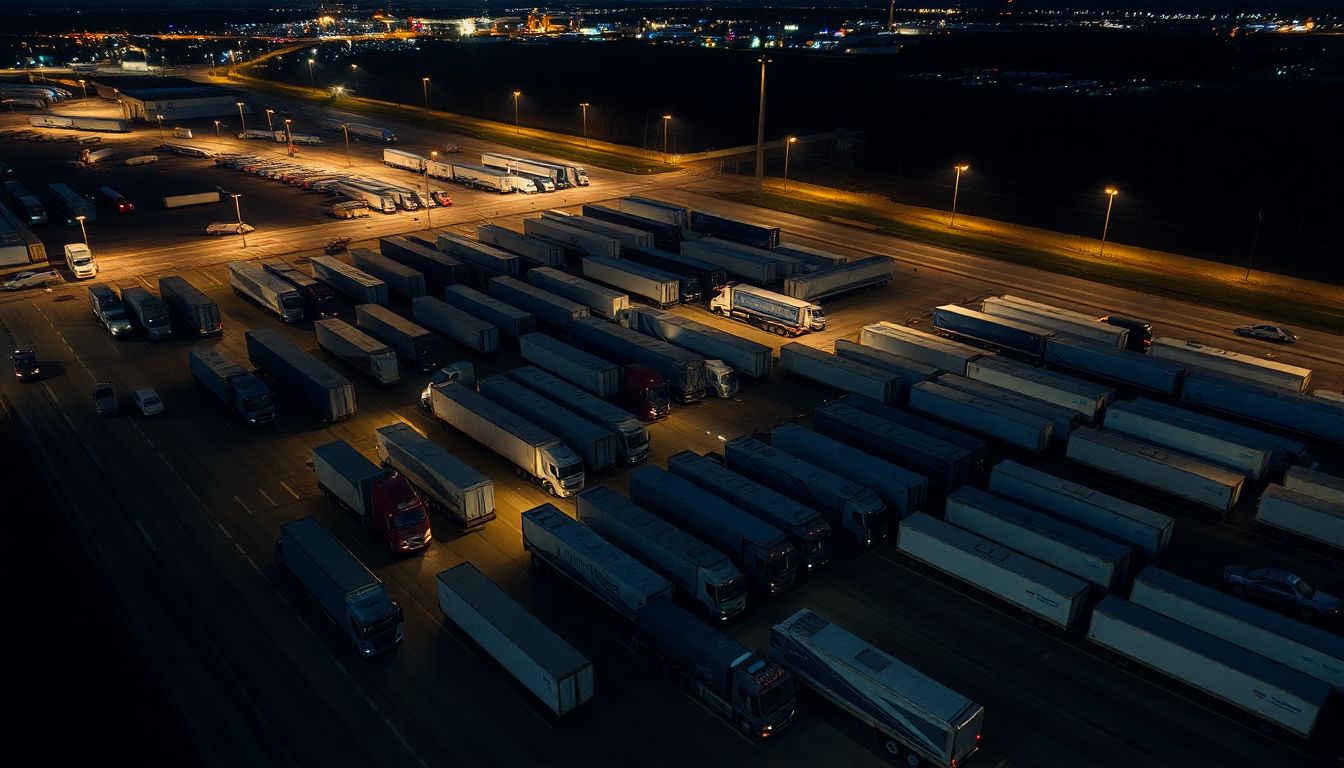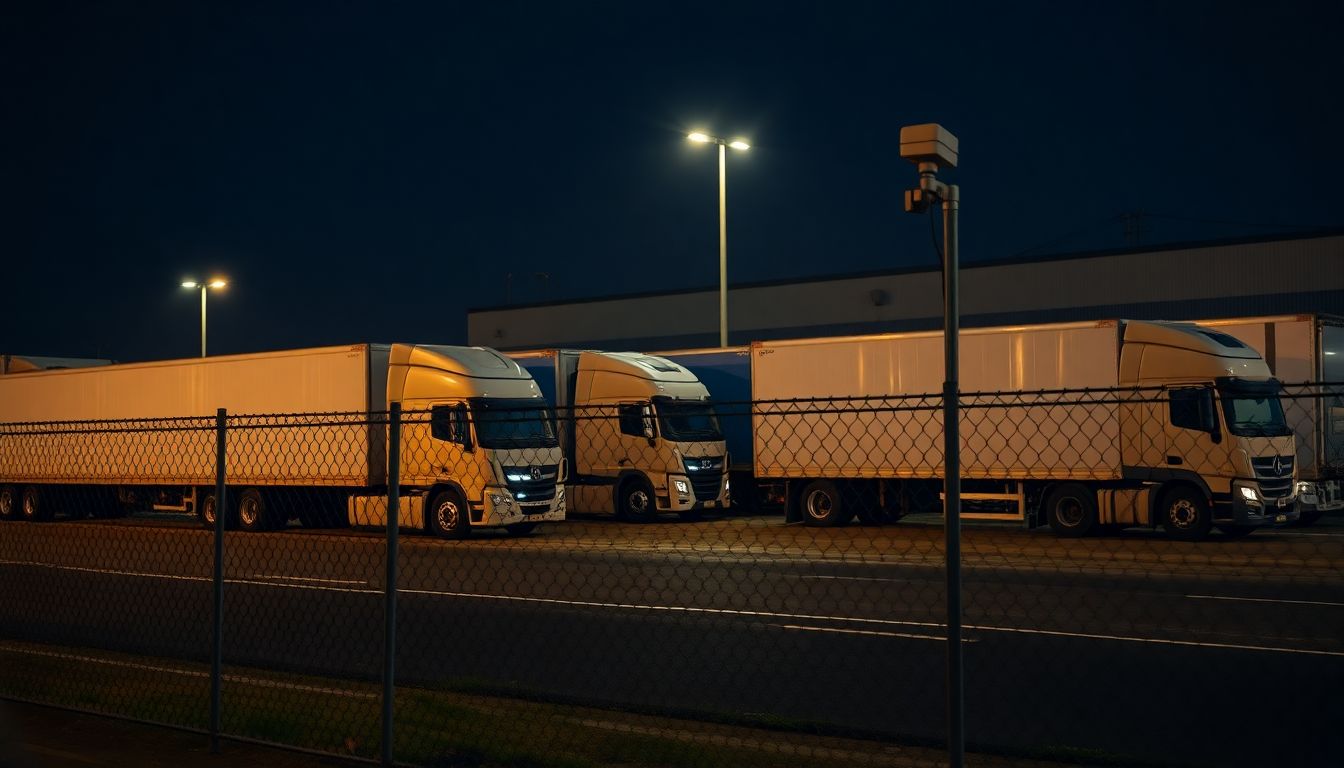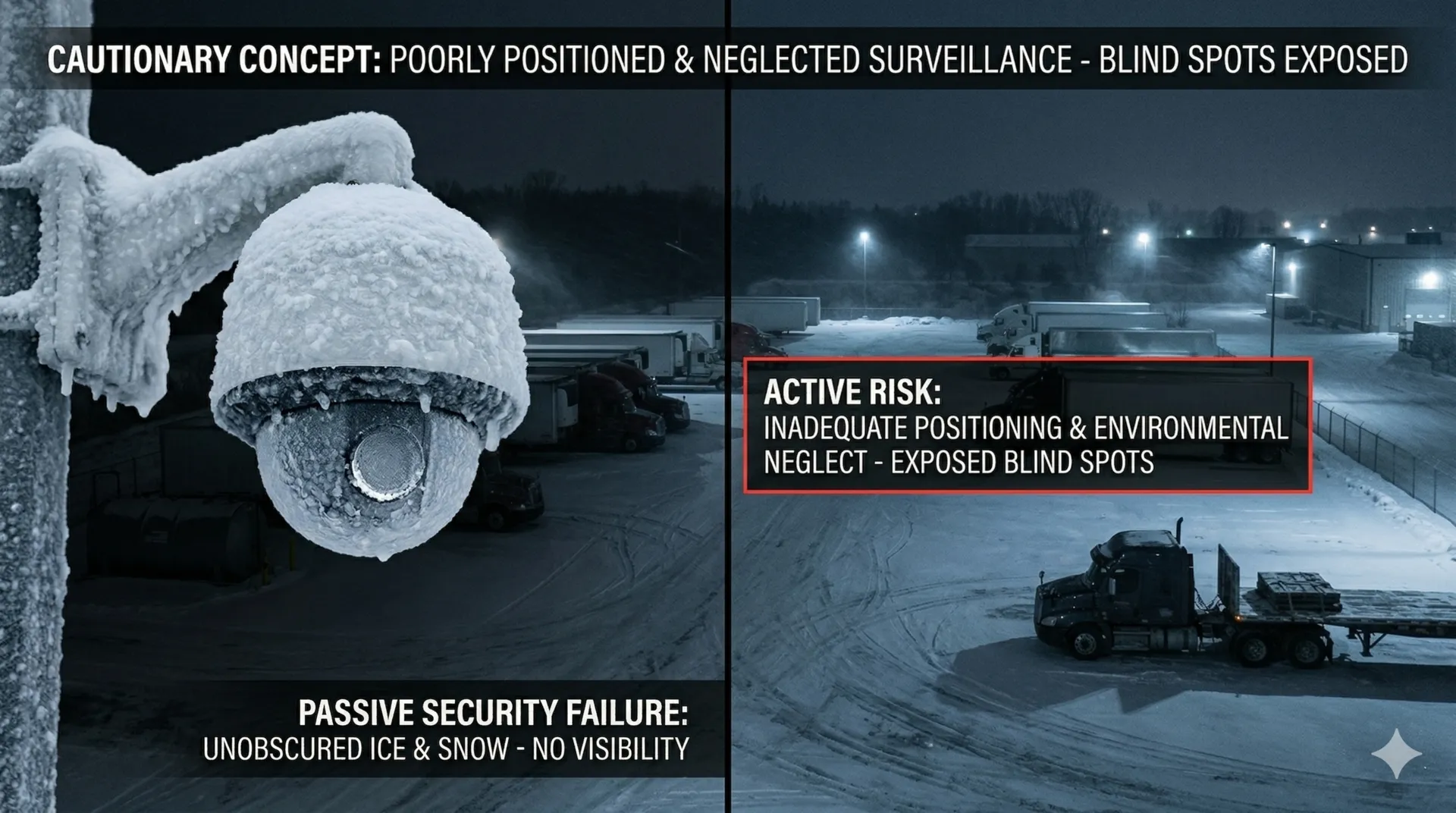
Most truck yards we walk into have cameras. They're usually mounted too high, aimed too wide, recording to a dusty DVR in a back office nobody checks. The owner calls them a "security system." They're not. They're a recording system — and they only matter after something has already gone wrong.
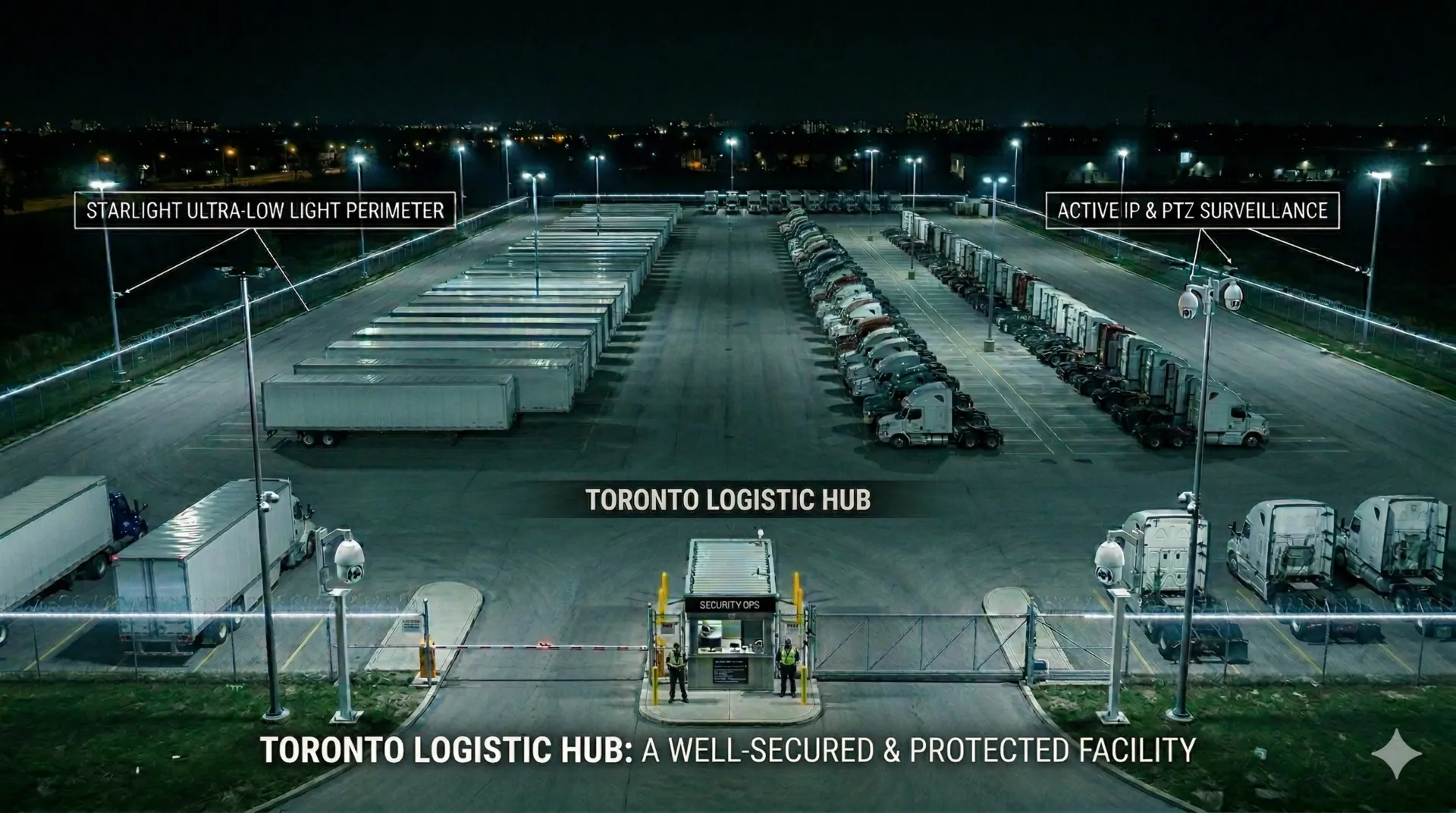
A properly secured truck yard is designed differently from the ground up. Every component serves a specific function: detect, deter, verify, respond. Here's what best-in-class actually looks like, section by section.
Perimeter: The First Line of Defence
The perimeter is where most yards fail. They mount one or two cameras near the gate and call it done. A properly secured yard treats the entire fence line as the detection boundary.
At each corner of the yard, you install PTZ (pan-tilt-zoom) cameras with 360-degree rotation capability. These cover the full fence line in both directions from each corner, giving you overlapping fields of view with no blind spots. Between the corners, fixed cameras are mounted every 30-50 metres along the fence line, each covering a specific zone. The fixed cameras provide constant coverage of their assigned area while the PTZ cameras can be directed by operators to track specific activity.
For night-time detection, IR illuminators are mounted alongside the perimeter cameras. These flood the fence line with infrared light invisible to the human eye but crystal clear to the cameras. The result: full-colour-quality footage at 2 AM without lighting up the yard like a stadium and annoying neighbouring properties. Some yards also add thermal cameras on the perimeter for early detection — thermal picks up a human body approaching the fence from 200+ metres away, triggering an alert before anyone reaches the property boundary.
Gate: The Control Point
The gate is where every vehicle and person enters and exits. It's also where most cargo theft investigations start — "What truck left at 3 AM and what was on it?"
A properly secured gate has an ANPR (Automatic Number Plate Recognition) camera aimed at incoming and outgoing lanes. Every plate is captured, logged with a timestamp, and stored. When a trailer goes missing, you don't need to scrub hours of footage — you search by plate number and get every entry and exit for that vehicle instantly.
Next to the ANPR camera, a two-way audio intercom connects directly to the monitoring station. After-hours visitors press the call button and speak with a live operator who can verify their identity, check them against an approved access list, and either grant or deny entry. The intercom integrates with a barrier arm or gate motor — the operator can open the gate remotely without anyone on site needing to be involved.
A separate high-resolution fixed camera is aimed at the gate to capture the driver's face and any passengers. Combined with the ANPR plate capture, you have a complete record: who arrived, what they were driving, and exactly when.
Loading Docks: Where the Value Is
Cargo theft doesn't always happen over the fence. Sometimes it happens at the dock — unauthorized loading, employees moving product to the wrong truck, or drivers taking more than their manifest allows. Every dock door gets its own dedicated fixed camera positioned to capture who is at the door, what's being loaded or unloaded, and which truck is backed up to the bay.
These cameras are set to a narrow field of view with high resolution, so you can read box labels and identify product types in the footage. When a shipper calls to say a pallet is missing, you pull up the dock camera for that bay and that time window. The answer is right there — no guesswork, no finger-pointing.
Lighting: Eliminating Dark Zones
Cameras are only as good as what they can see. Even with IR illuminators, proper lighting transforms footage quality and, more importantly, acts as a deterrent. A well-lit yard signals that the property is actively maintained and monitored.
LED flood lights with motion triggers are installed across the yard, covering every aisle between parked trailers and every walkway. When someone moves through an area, the lights activate — bright enough to startle an intruder and illuminate the area for camera capture. Continuous lighting at the gate, dock area, and office entrances provides baseline visibility around the clock. The goal is zero dark zones anywhere on the property.
Signage and Visible Deterrence
Deterrence happens before detection. The cheapest security measure on the entire property is a sign — and it's one of the most effective. Visible "24/7 Live Monitored" signs are posted at every entry point, along the fence line, and at loading docks. These aren't generic "cameras in use" signs — they specifically state that a live operator is watching in real time.
On the cameras themselves, small LED indicator lights show they're active. A blinking red light on a camera tells someone looking at it that they're being recorded right now. Combined with the signage, this creates a layered deterrence message: you're being watched, you're being recorded, and someone will respond. Many intrusion attempts end at the fence when the would-be intruder sees these indicators and decides the yard isn't worth the risk.
NVR + Cloud: Recording That Survives
All cameras feed to a local NVR (Network Video Recorder) on site, typically stored in a locked, ventilated server cabinet. The NVR retains 30-90 days of continuous footage depending on camera count and resolution settings. This is your primary archive — it's fast to search, doesn't depend on internet bandwidth, and survives internet outages.
Critical clips — alarm events, gate entries, any operator-flagged incidents — are automatically backed up to cloud storage. If someone breaks into the office and steals the NVR (it happens), the important footage is already off-site. Cloud backup also allows remote access: the monitoring station can pull footage from any camera without depending on the local network being up.
Monitoring Station: The Human Element
This is what separates a camera system from a security system. At the monitoring station, trained operators watch live feeds from the yard on multi-screen displays. They're not watching every camera simultaneously — that's impossible and ineffective. Instead, the system uses analytics-based alerts: motion in a restricted zone, a vehicle at the gate, someone approaching the fence line at an unusual hour.
When an alert triggers, the operator sees the relevant camera feed pop up on their primary screen. They verify the threat — is it a person, an animal, a piece of debris blowing across the yard? If it's a real threat, they escalate: activate the two-way audio to issue a verbal warning ("You are on private property and are being recorded — leave immediately"), call police dispatch with the exact location and description, and notify the yard owner or manager. Average response time from alert to police dispatch: under 30 seconds. That's faster than any guard walking to the incident location.
Phone Access: The Owner's Window
The yard owner or operations manager has full access to every camera from their phone. Open the app, tap a camera, see a live feed. Get push notifications when an alarm triggers. Pull up recorded clips from any time window. Check who entered the gate last night. Verify a delivery without driving to the yard.
This isn't a "nice to have" — it's how modern yard operators manage their properties. When a driver calls at 11 PM saying they can't get in, the owner checks the gate camera from bed, confirms the driver's identity, and remotely opens the barrier. No late-night drive to the yard. No security guard needed for a routine access request.
What This Costs — And What It Saves
A full security system for a mid-sized truck yard — 16-24 cameras, ANPR, intercom, lighting upgrades, NVR with cloud backup — typically runs $25,000-$45,000 installed. Monthly live monitoring adds $2,500-$4,000 depending on hours and camera count. That sounds significant until you compare it to a single cargo theft averaging $150,000-$350,000 in losses, or the $8,000-$15,000/month cost of a single security guard who can only be in one place at a time.
The yards that invest in proper security don't do it because they like spending money. They do it because they've done the math — or because they've already been hit once and know exactly how much "good enough" security actually costs.
Get Your Yard Assessed
We'll walk your yard, identify every gap, and design a system that covers it end to end. No obligation, no pressure — just a clear picture of what proper security looks like for your specific property. Call (905) 550-0490) or visit our live video monitoring page to book a free site assessment.