We've inspected dozens of truck yard camera systems across Southern Ontario. The pattern is remarkably consistent: the cameras are there, the NVR is recording, and the system technically works — but when theft actually happens, the footage is useless. The cameras didn't prevent anything and the recordings don't help the police report. The hardware isn't the problem. The way the system was designed, installed, and managed is the problem.
Here are the five most common failure modes we see in truck yard camera systems — and the fix for each one.
1. Night Vision Fails: Cheap IR vs. Starlight Sensors
Truck yards are targeted at night. That's when trailers are sitting unattended, gates are unmanned, and thieves have hours to work. So night vision isn't a nice-to-have — it's the entire point of the system.
Most budget cameras use basic infrared (IR) LEDs for night vision. They blast invisible IR light outward and capture the reflection. The problem: cheap IR cameras produce a narrow cone of usable light that fades rapidly past 10 metres. Beyond that range, you get either a white-out glare from surfaces that reflect too much IR, or pitch-black footage where nothing is visible. A person 20 metres away is a dark silhouette — no face, no clothing detail, no plate number on the truck they're approaching.
Starlight sensors are fundamentally different. Instead of relying on IR illumination, they use large-aperture lenses and ultra-sensitive image sensors that capture usable colour video in near-total darkness — down to 0.001 lux. In a truck yard with even minimal ambient light (a distant streetlight, moonlight, a building's emergency exit sign), a starlight camera produces clear, colour footage at 30+ metres. You see faces. You see plates. You see what someone is carrying.
The fix: Every camera covering outdoor yard space should use a starlight sensor — not basic IR. The per-camera cost difference is $100–$200. On a 16-camera system, that's $1,600–$3,200 more for cameras that actually work when they're needed most. There's no scenario where saving that money makes sense.
2. Wrong Placement: Cameras Aimed at Nothing Useful
This is the failure we see most often, and it's usually the result of cameras being installed by someone who understands cameras but doesn't understand truck yards. We walk into yards where cameras are pointed at the middle of an empty lot, covering 200 square metres of asphalt that nobody is going to steal. Meanwhile, the gates have no camera, the loading docks have blind spots, and the trailer parking rows have zero coverage between units.
Truck yards have specific high-risk zones:
- Entry and exit gates: Every vehicle and person entering or leaving needs to be captured with enough resolution to read plates and identify faces. This means dedicated cameras at each gate — not wide-angle overviews that catch gates at the edge of the frame.
- Loading docks: Cargo is most vulnerable during loading and unloading. Cameras should cover every dock door plus the staging areas where freight sits waiting to be loaded.
- Trailer rows: Thieves cut trailer seals and unload cargo between parked units where they're concealed from view. Cameras need to cover the narrow corridors between trailer rows — not just the ends.
- Perimeter fence lines: The fence is where people get in. Coverage along the full perimeter catches breach attempts before they reach the cargo.
- Fuel stations and equipment storage: Fuel theft is rampant. Equipment sheds and tool storage are easy targets.
The fix: Camera placement should start with a site walk, not a floor plan. Walk the yard at night. Identify every entry point, every high-value zone, every blind spot between trailers. Then design camera positions to cover those specific risks. A professional site survey for a truck yard takes 2–3 hours and eliminates the guesswork that leads to wasted cameras.
3. No Monitoring: Recording to an NVR Nobody Checks
This is the most expensive failure because it means the entire system is reactive instead of preventive. The cameras record. The NVR stores 30 days of footage. And nobody looks at any of it until Monday morning when someone notices a trailer seal is broken or equipment is missing. Then someone spends hours scrubbing through footage, finds the theft happened at 3:17 AM on Saturday, and now has a video of someone stealing from you — but they're already gone with your cargo.
A camera system without monitoring is a documentation system, not a security system. It helps with insurance claims. It doesn't prevent theft.
The fix: Live video monitoring with trained operators. When someone enters the yard after hours, an operator sees them within seconds, activates two-way audio ("You are being recorded — authorities have been contacted"), and dispatches police while the intruder is still on site. Most intruders flee immediately upon hearing the audio warning. The theft doesn't happen. The cargo stays on the trailer. That's the difference between recording a crime and preventing one.
For yards that aren't ready for full monitoring, at minimum set up motion-triggered alerts to your phone with AI analytics that filter out animals, blowing debris, and passing traffic. You'll still need to respond personally — but at least you'll know something is happening in real-time instead of discovering it 48 hours later.
4. Weather Kills Equipment: Not Rated for Ontario Winters
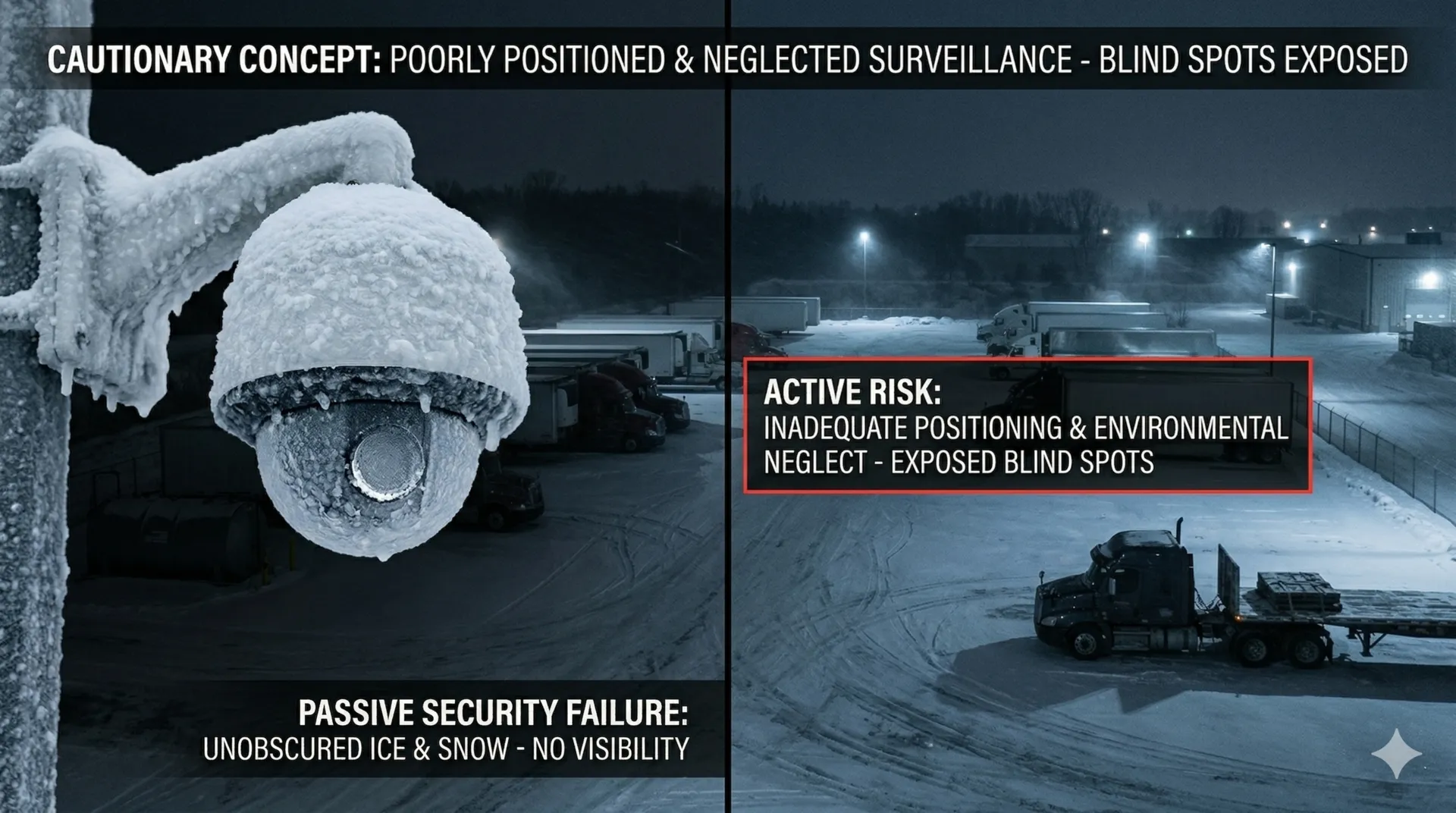
Southern Ontario is brutal on outdoor electronics. Temperatures swing from +35°C in summer to −25°C or colder in winter. Freeze-thaw cycles happen dozens of times per season. Cameras that are "outdoor rated" by California standards fail consistently in Canadian conditions.
The failures we see repeatedly:
- Lens fogging: When temperatures drop rapidly, moisture condenses inside the camera housing and fogs the lens. The camera is running, the NVR is recording, but every frame is a white blur. You discover this only when you need the footage.
- Housing cracks: Cheap plastic housings become brittle in sustained cold and crack, allowing moisture inside. Once water gets in, corrosion kills the electronics within weeks.
- Heater failures: Cameras with internal heaters are rated for cold weather — but the heater is a component that can fail. If the heater dies in November, the camera may still operate for a few weeks before condensation and frost render it useless. Without proactive monitoring of camera health, nobody knows the heater failed until the footage is needed.
- Cable degradation: Exposed outdoor cable runs crack and split in freeze-thaw cycles. Water wicks into the cable, corrodes the conductors, and the camera starts dropping frames or going offline intermittently.
The fix: Specify cameras rated for at least −40°C operating temperature with IP67 ingress protection. Use cameras with internal heaters and defog capability. Run all outdoor cable in UV-rated conduit, and use gel-filled or direct-burial rated Ethernet cable for any below-ground or exposed runs. And implement camera health monitoring — automated alerts when a camera goes offline, drops below expected frame rates, or reports abnormal internal temperatures. A camera that fails silently is worse than no camera at all, because it creates a false sense of coverage.
5. Internet Dependency: Cable Cut = No Recording or Remote Access
Many modern camera systems are designed around internet connectivity. Cloud-based platforms require internet to store footage. Remote access apps need internet to connect. Some systems even depend on cloud servers for basic functionality — without internet, the cameras record but you can't view, search, or export footage from the NVR.
This creates a single point of failure. A thief who cuts the internet cable (usually an exposed coax or fiber line on the exterior of the building) can disable cloud recording, remote access, and monitoring alerts in one snip. If the NVR is set to cloud-primary storage, footage may not be saved at all.
Even without intentional sabotage, internet outages happen. An ISP outage at 2 AM means your monitoring centre can't see your cameras, your phone app shows nothing, and if the system is cloud-dependent, recording may stop entirely.
The fix: Always record locally first. The NVR should store all footage on-site on its own hard drives, regardless of internet status. Cloud backup or offsite replication is a bonus layer — not the primary storage. For monitoring, use a cellular failover: if the primary internet goes down, a cellular modem automatically takes over and maintains the connection to the monitoring centre. This adds $50–$100/month for a commercial cellular data plan, but it eliminates the single point of failure. For high-value yards, consider dual ISP connections (cable + fiber from different providers) with automatic failover — the odds of both going down simultaneously are negligible.
The Truck Yard Camera System That Actually Works
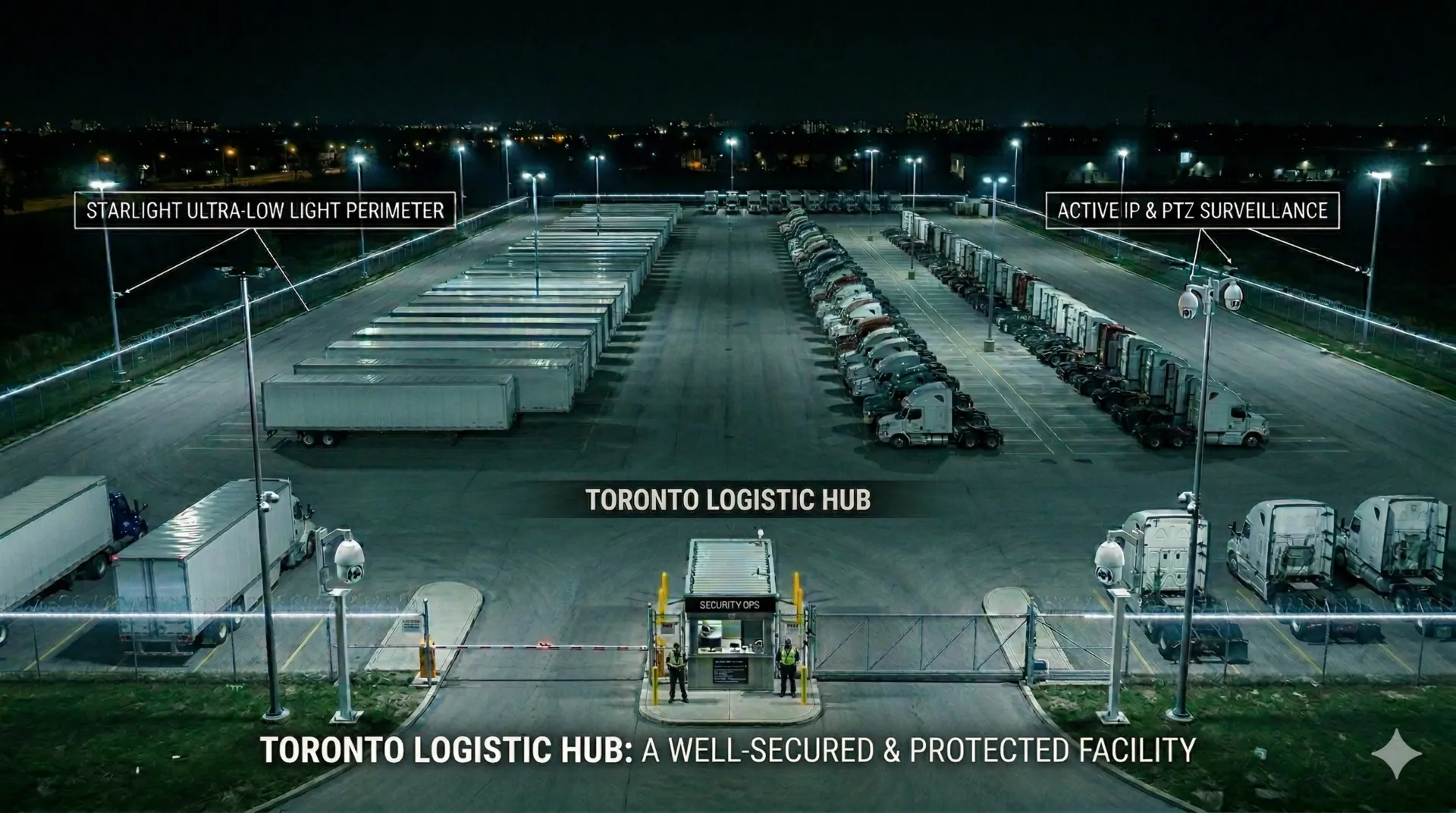
A system that avoids all five failure modes looks like this: starlight cameras at every high-risk zone, professionally placed based on an on-site survey, connected to a local NVR with 30+ days of retention, monitored by live operators during after-hours, rated for −40°C with internal heaters and IP67 housing, and connected via hardwired network with cellular failover.
That's not a premium luxury system — it's the minimum for a truck yard that's actually protected. Anything less is a system that looks like security but doesn't deliver it when it counts.
If your truck yard cameras are underperforming — or if you're installing a system for the first time — we'll do a free site survey and show you exactly where the gaps are. Call us at (905) 550-0490) or visit our security camera installation page for details.